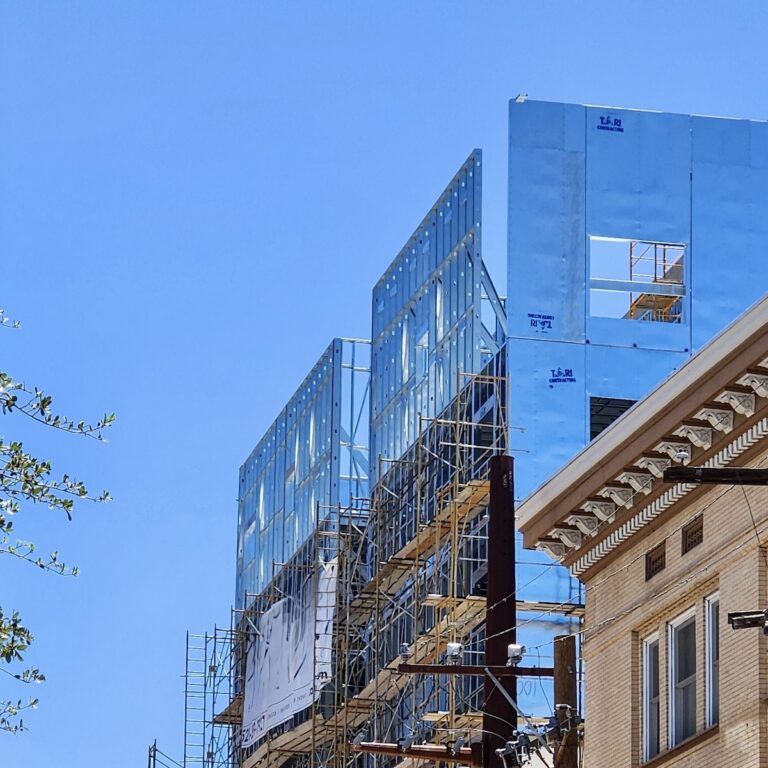
7 Ways Cold-Formed Steel Improves Multi-Family Project Budgets
What Is Cold-Formed Steel Framing for Multi-Family Construction?
Cold-formed steel (CFS) framing reduces multi-family construction costs by up to 30% while compressing project timelines by several months, according to SFIA industry data. The savings compound from high strength-to-weight ratios that reduce foundation loads, lower insurance premiums from non-combustible classification per ASTM E136, and factory-prefabricated assembly that accelerates schedules and improves on-site efficiency.
CFS consists of steel sheet bent into structural shapes at room temperature—distinct from the hot-rolled structural steel used in high-rise buildings. CFS members including studs, joists, and tracks are engineered per AISI S100 standards and classified as non-combustible under ASTM E136 testing. For mid-rise multi-family projects—typically four to eight stories under IBC definitions—CFS serves as the primary load-bearing system for walls, floors, and roof framing.
- Cold-formed steel (CFS): Steel sheet bent into structural shapes at room temperature, not heated like hot-rolled structural steel.
- Non-combustible construction: Materials that do not ignite or contribute fuel per ASTM E136 testing.
- Mid-rise multi-family: Typically four- to eight-story residential buildings under IBC definitions.
1. Eliminating Podium Construction for Buildings Above Four Stories
CFS framing delivers its largest budget impact at five stories and above, where it eliminates the concrete podium that wood-framed buildings require under IBC Section 510.2. Depending on building footprint, podium elimination alone can save over $730,000 and compress the schedule by 8–12 weeks.
IBC 2021 Construction Type Requirements for Mid-Rise Wood Framing
IBC Table 504.4 limits combustible wood framing (Type IIIA/IIIB) to specific heights based on occupancy and sprinkler protection. Buildings above four stories using wood require a non-combustible podium base per IBC Section 510.2 horizontal building separation, which effectively "resets" the height calculation and allows wood framing to continue above.
In Massachusetts, 780 CMR adopts IBC provisions with state-specific amendments. Project teams working in the region should verify local requirements during early design phases.
Non-Combustible CFS Path to Type IIA Without Podium
Because CFS qualifies as non-combustible per IBC 602.2, it enables Type IIA construction from ground level to roof—no podium separation required. Fire-rated assemblies using UL Design H514 or H505 achieve the required hourly ratings through gypsum board protection of the steel framing.
Beyond cost savings, this construction path simplifies the overall structural system by eliminating the concrete-to-wood transition that frequently creates coordination challenges between trades.
Podium Elimination Savings per Square Foot
| Construction Path | Podium Required | Applicable Heights | Typical Added Cost |
|---|---|---|---|
| Type IIIA Wood | Yes, above 4 stories | 5–6 stories with podium | $12–15/SF + 8–12 weeks |
| Type IIA CFS | No | 5+ stories, ground to roof | Baseline |
Source: RSMeans 2024, BuildSteel.org case studies. Costs reflect first-cost comparison for equivalent building footprint.
2. Reducing Framing Material Costs at Five Stories and Above
CFS framing reaches cost parity with wood at five stories. Above that threshold, the CFS advantage grows as fire-retardant-treated (FRT) lumber requirements and podium costs compound with increasing building height.
Cost Crossover Analysis: CFS vs. Wood by Building Height
At four stories and below, wood framing typically maintains a lower first-cost—and wood remains appropriate for many projects at those heights. However, the economics shift at five stories. FRT lumber, stainless steel fasteners, and podium construction costs accumulate on the wood side. Per RSMeans 2024 data for the Boston market, CFS provides approximately $7.50/SF savings at six stories compared to the FRT wood path.
FRT Lumber Price Premiums and Procurement Delays
Fire-retardant treatment adds 10–25% to lumber costs while reducing structural capacity, often requiring larger member sizes. Stainless steel fasteners required with FRT lumber add $0.25–0.40/SF, and procurement lead times extend 6–12 weeks beyond standard lumber.
Northeast Regional Pricing for CFS Multi-Family Projects
Boston-area projects face additional considerations under 780 CMR and stretch energy code requirements. CFS panelization can reduce exposure to the skilled framing labor shortages that have affected New England project schedules in recent years.
Lumber prices have historically shown volatility swings of up to 300% (March 2020 to May 2021), while cold-formed steel pricing remains comparatively stable. That volatility represents a material budget risk factor worth addressing during early project planning.
3. Lowering Property Insurance Premiums with Non-Combustible Construction
Non-combustible CFS construction commands lower property insurance premiums than combustible wood framing—a lifecycle cost factor that compounds over the building's operating life. Documented projects show up to 38.2% cumulative insurance savings over 30 years.
Annual Premium Differences: Combustible vs. Non-Combustible Buildings
Insurance underwriters classify buildings by construction type, and non-combustible structures present lower fire propagation risk. The premium differential typically ranges from 25–40% annually for comparable buildings with equivalent coverage levels.
Thirty-Year Insurance Savings Using Net Present Value
For a 68,498 SF residential building, BuildSteel.org case study data shows approximately $666,000 in insurance savings over 30 years using a 4% discount rate. This represents real budget impact that often goes unaccounted in first-cost comparisons between framing systems.
Builder's Risk Reduction During Construction Phase
Builder's risk insurance during construction is also lower for non-combustible framing. Wood-framed buildings under construction have experienced significant fire losses in recent years, including total structural failures. The non-combustible classification of CFS per ASTM E136 reduces this exposure during the construction period when buildings are most vulnerable.
4. Accelerating Project Schedule to Reduce Carrying Costs
CFS panelization compresses framing schedules by 50–60% compared to stick framing, according to SFIA data. That schedule compression translates directly to reduced construction loan interest and earlier tenant occupancy.
Prefabricated Panel Assembly vs. Stick Framing
Factory-built CFS panels arrive ready for erection rather than requiring individual member cutting and fastening on site. This approach shifts labor hours from weather-exposed field conditions to controlled shop environments.
The precision manufacturing process—using HOWICK roll-forming machinery and CAD/3D modeling—validates load-bearing calculations on digital models before fabrication begins. By the time panels reach the site, the engineering is already proven per AISI S100 and S240 standards.
Weather Delay Mitigation Through Factory Manufacturing
Factory-controlled manufacturing eliminates weather delays during panel fabrication. While panel erection on site remains weather-dependent, the compressed duration reduces overall exposure to variable conditions. In New England, where precipitation and freeze-thaw cycles create unpredictable construction windows, this advantage is significant.
Monthly Carrying Cost Savings from Earlier Tenant Occupancy
Earlier completion enables faster lease-up and rent collection. Every month of schedule acceleration reduces construction loan interest while advancing the start of revenue generation—a compounding financial advantage that improves project IRR.
5. Improving Labor Productivity with Factory-Built Components
Panelized CFS requires up to 20% fewer on-site labor hours than stick framing, according to SFIA data. This addresses labor availability challenges while reducing wage exposure during the project duration.
On-Site Labor Hour Reduction Through Panelization
Factory panelization shifts labor from field to shop, where productivity is higher and quality control is more consistent. Fewer field labor hours per square foot means less exposure to the skilled labor shortages affecting Northeast construction markets.
Precision Manufacturing with HOWICK Machinery and CAD Modeling
Computer-controlled roll-forming equipment produces CFS members to tolerances of ±1/8"—significantly tighter than field-cut lumber at ±1/4" to ±3/8". Pre-punched connections and labeled components reduce field interpretation and rework.
- Tighter tolerances: ±1/8" fabrication tolerance versus ±1/4" to ±3/8" for field-cut lumber
- Pre-punched connections: Fastener locations determined during engineering per AISI S240, not in the field
- Labeled components: Each member identified for its specific location in the assembly
- Digital validation: Load-bearing calculations completed on 3D models before fabrication per AISI S100
Trade Availability and Wage Pressure in Northeast Markets
Massachusetts and New England face ongoing skilled framing labor constraints. CFS panelization reduces total field labor hours required, providing insulation from wage escalation and availability issues during project execution.
6. Minimizing Thirty-Year Maintenance and Repair Expenses
CFS framing materials do not degrade from moisture, pests, or rot—eliminating entire categories of maintenance expense that affect wood-framed buildings over their operating life. BuildSteel.org data documents approximately $585,848 in maintenance savings over 30 years (NPV at 4% discount rate) for a 68,498 SF building.
Moisture, Pest, and Fire Resistance Compared to Wood Framing
The performance differences between CFS and wood become more pronounced over time:
- Moisture response: CFS experiences negligible dimensional change, while wood framing shrinks 3–8% cross-grain, causing nail pops, drywall cracks, and floor squeaks
- Pest resistance: CFS is immune to termites and carpenter ants, while wood requires ongoing treatment in vulnerable regions
- Fire behavior: CFS is non-combustible per ASTM E136, while wood contributes fuel load if fire-rated assemblies are breached
Lifecycle Maintenance Cost Projections for CFS Buildings
The $585,848 in documented 30-year maintenance savings come primarily from eliminated rot repair, pest treatment, and moisture remediation—expenses that simply do not apply to steel framing. These savings compound with the insurance premium reductions discussed in Section 3.
Asset Value Preservation Over Multi-Decade Holding Periods
Structural frame durability affects residual asset value. A CFS frame's condition remains stable over decades, while wood frames may show degradation that affects refinancing, sale valuation, or recapitalization decisions.
7. Reducing Bid Contingency Through Predictable Construction Performance
CFS systems demonstrate lower schedule variance and fewer field change orders than conventional framing. Documented projects show less than 7% schedule variance for panelized CFS versus 15–25% for conventional framing—enabling contractors to bid with lower contingency and owners to budget with greater confidence.
Dimensional Tolerance Consistency in CFS Fabrication
Factory fabrication per AISI S240 standards achieves tighter dimensional tolerances than field-cut lumber. Consistent dimensions reduce fit-up issues with mechanical, electrical, and finish trades—the kind of issues that frequently drive change orders.
Schedule Variance Reduction with Pre-Engineered Systems
Pre-engineering resolves coordination issues before field work begins. The digital modeling process identifies conflicts during design rather than during construction, when changes are most expensive to address.
Risk Factor Comparison for Project Cost Estimating
- Material price stability: CFS pricing is less volatile than lumber, which has shown historical swings of up to 300%
- Weather exposure: Factory fabrication reduces weather-dependent work
- Labor predictability: Panelized assembly delivers more consistent productivity than stick-framing
How CFS Compares to Structural Steel for Multi-Family Buildings
Cold-formed steel and hot-rolled structural steel serve different applications in multi-family construction. Understanding the distinction helps project teams specify the appropriate system.
Material Properties and Application Differences
CFS uses thin sheet steel (typically 18–54 mil) formed into C-shapes and tracks, designed per AISI S100. Structural steel uses thick hot-rolled shapes (W-sections, HSS) designed per AISC 360. CFS is typically used for load-bearing walls in mid-rise residential construction, while structural steel handles columns, beams, and moment frames in larger or more complex structures.
Cost Comparison for Four- to Eight-Story Residential
CFS load-bearing wall systems are typically more cost-effective than structural steel frames for mid-rise residential with repetitive unit layouts. Structural steel may be appropriate for long spans, irregular geometry, or mixed-use podiums. Some projects combine both systems in a hybrid approach.
Specifying CFS vs. Hot-Rolled Steel for Mid-Rise Projects
- CFS preferred: Repetitive unit layouts, load-bearing wall systems, typical mid-rise residential
- Structural steel preferred: Long spans, transfer conditions, high seismic/wind loads, irregular geometry
- Hybrid approach: Structural steel podium with CFS residential floors above
Frequently Asked Questions About Cold-Formed Steel Budget Impacts
What are the disadvantages of cold-formed steel for multi-family construction?
CFS requires specialized design expertise per AISI S100 and S240 standards and may have higher first-cost than wood at four stories or below. Thermal bridging through steel studs requires continuous insulation detailing to meet energy code requirements, including Massachusetts 780 CMR stretch code provisions.
At what building height does cold-formed steel framing become more cost-effective than wood framing?
Cost parity typically occurs at five stories, where FRT lumber requirements and podium construction per IBC Section 510.2 begin affecting wood-frame budgets. The CFS advantage increases at six stories and above, with RSMeans 2024 data showing approximately $7.50/SF savings in the Boston market.
How does cold-formed steel framing perform in New England climate conditions?
CFS is unaffected by moisture, freeze-thaw cycles, and humidity variations that cause dimensional movement in wood framing. Thermal performance depends on wall assembly design meeting 780 CMR stretch energy code requirements—proper continuous insulation detailing is essential for code compliance and energy efficiency.
Get a CFS Feasibility Analysis for Your Multi-Family Project. The budget impact of CFS depends on specific project parameters—height, footprint, location, and code requirements all affect the comparison. Contact AAC Steel for a project-specific feasibility analysis with side-by-side cost comparison for your next multi-family development.