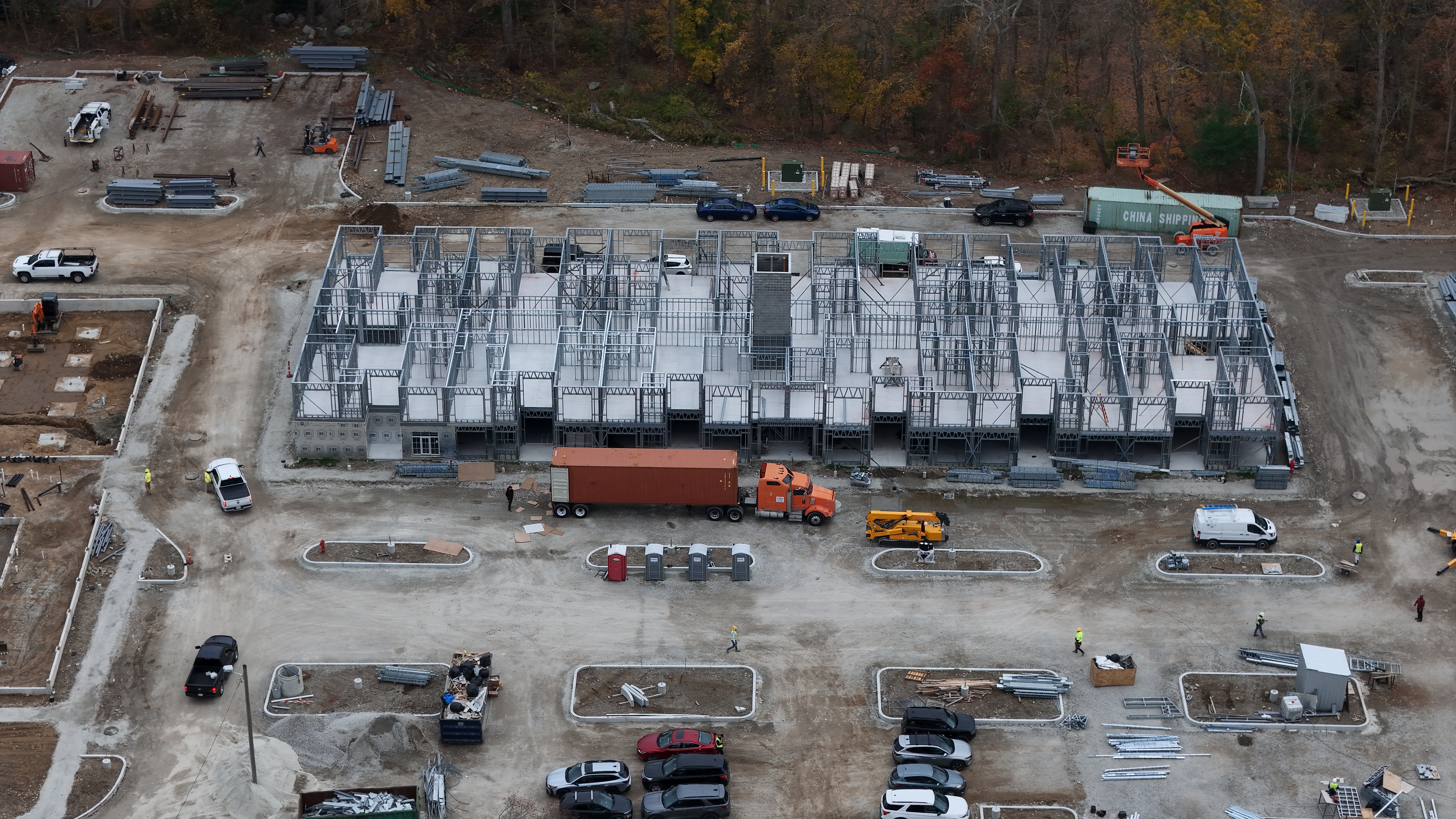
How Cold-Formed Steel Reduces Multi-Family Construction Costs
Cold-formed steel (CFS) framing delivers measurable budget reductions on multi-family projects through three converging mechanisms: faster framing timelines (up to 50% reduction in framing duration), lower material waste (under 2% factory scrap rates), and reduced insurance premiums (35-75% lower across multiple policy categories). For developers targeting 4-8 story multi-family construction, these savings compound into six- and seven-figure cost avoidance that fundamentally changes the financial viability equation.
BuildSteel.org case studies document over $400,000 in direct savings on individual projects and 20-30% total cost reductions versus wood framing on mid-rise multi-family buildings where CFS eliminates the need for concrete podium construction. These are not theoretical projections — they reflect completed projects where developers compared actual CFS costs against wood-frame bids on the same building programs.
Cold-formed steel is structural steel sheet formed into studs, joists, tracks, and headers at room temperature — without heating or hot-rolling. CFS framing is engineered per AISI S100, North American Specification for the Design of Cold-Formed Steel Structural Members, and classified as non-combustible per ASTM E136, the standard test method for assessing combustibility using a vertical tube furnace at 750°C. This non-combustible classification is the single most consequential attribute driving CFS budget advantages at mid-rise heights, because it determines IBC construction type, which in turn determines allowable building height, required fire protection systems, and insurance classification.
The budget impact of CFS is most significant at 4-8 stories — the height range where wood framing encounters escalating code requirements (fire-retardant treatment, podium construction, reduced allowable heights) while CFS maintains consistent cost-per-square-foot performance. Below 4 stories, wood's lower material cost typically prevails. Above 8 stories, structural steel or concrete systems become necessary. The 4-8 story sweet spot is precisely where multi-family development is most active in urban and suburban markets nationwide.
Material and Labor Savings Per Square Foot
The Park 4200 project in Dallas, Texas — a 99,000 SF multi-family development documented by BuildSteel.org — achieved $4.20 per square foot in direct savings by selecting CFS over wood framing, translating to over $400,000 in total project savings. This cost differential resulted from the combined effect of prefabrication efficiency, reduced labor hours, and elimination of fire-retardant lumber premiums that the wood-frame alternative required at that building height.
CFS prefabricated panels arrive at the job site labeled, sequenced, and ready for installation. Each panel is factory-fabricated on HOWICK roll-forming machinery from CAD/BIM models, with every stud, header, and opening pre-cut and pre-punched. Crews install panels by lifting them into position, plumbing, and fastening — a fundamentally different process than stick-framing individual members from loose lumber on scaffolding.
This prefabrication model drives measurable labor efficiency advantages:
- Reduced crew sizes: CFS panel installation typically requires 4-6 framers per floor versus 8-12 for wood stick-framing, a 40-50% reduction in on-site labor headcount
- Assembly versus stick-framing: Panelized CFS converts framing from a skilled trade operation (measuring, cutting, fitting) to an assembly operation (positioning, plumbing, fastening), reducing the skill threshold and expanding the available labor pool
- Fewer trades on-site simultaneously: Factory prefabrication moves cutting and fabrication off the critical path, reducing trade stacking and coordination conflicts
- Consistent installation rates: CFS panelized framing achieves 800-1,200 SF of wall area per crew per day versus 400-600 SF for wood stick-framing (SFIA field data)
- Reduced supervision overhead: Pre-labeled, sequenced panels reduce layout errors and the need for on-site engineering oversight during framing
Precision Fabrication Eliminates On-Site Waste
CFS panels fabricated on HOWICK roll-forming machinery from integrated CAD/3D BIM models achieve dimensional tolerances of ±1/8 inch — compared to wood framing tolerances of ±1/4 inch to ±3/8 inch under typical field conditions. This precision is not aspirational; it is inherent to the CNC-controlled roll-forming process, where every stud length, web punch-out, and clip location is machine-determined from the structural model.
The waste implications are substantial. Factory-controlled CFS fabrication generates scrap rates under 2% of total material, with steel scrap fully recyclable at commodity value. Wood stick-framing, by contrast, generates 10-15% material waste on typical multi-family projects (RSMeans 2024), with waste consisting of off-cuts, damaged members, and material rejected for warping, splitting, or excessive knots. On a 100,000 SF project, the difference between 2% and 12% waste represents tens of thousands of dollars in material cost — plus disposal fees, dumpster pulls, and lost productivity from managing waste streams on-site.
Precision fabrication also reduces change orders and rework. When framing members arrive pre-cut to exact dimensions, the cumulative tolerance stack-up that plagues wood-framed buildings — where small errors in individual members compound into misaligned walls, out-of-plumb conditions, and finish trade conflicts — is eliminated at the source. Fewer field corrections mean fewer change orders, fewer schedule disruptions, and lower total installed cost.
Price Stability Compared to Lumber Markets
Lumber price volatility has fundamentally undermined budget certainty for wood-framed multi-family projects. Between 2020 and 2023, framing lumber prices experienced swings exceeding 300%, with composite lumber futures ranging from under $350 per thousand board feet to over $1,500. Oriented strand board (OSB) — a critical sheathing material for wood-framed buildings — saw price increases of 510-650% during the same period (Random Lengths pricing data). For a developer who locked a construction budget based on lumber prices at bid time, a 200% increase in framing material cost during the procurement period could add $500,000-$1,000,000 to a mid-rise project.
Cold-formed steel pricing follows predictable industrial commodity patterns driven by global steel production capacity, scrap steel markets, and coil coating demand (SFIA market data). While steel prices are not immune to market forces, the volatility profile is fundamentally different: CFS pricing typically fluctuates within a 15-25% annual range versus lumber's 100-300% swings. Steel service centers and CFS fabricators can lock material pricing 12-18 months in advance with reasonable confidence, enabling developers to hold budget projections through the design-to-construction timeline without the speculative risk that lumber markets impose.
For developers presenting pro formas to investors and lenders, material price stability translates directly to budget forecasting confidence. A construction loan underwritten on a CFS cost estimate carries materially lower risk of cost overrun than one underwritten on a lumber-based estimate — a distinction that sophisticated lenders and equity partners increasingly recognize.
Eliminating Type IA Podium Construction for Mid-Rise Buildings
The single largest budget impact of cold-formed steel in multi-family construction is not a line-item savings — it is the elimination of an entire structural system. When CFS replaces wood framing at mid-rise heights, the concrete podium structure that the International Building Code requires for wood buildings above certain height thresholds is no longer necessary. This podium elimination represents the most significant cost avoidance opportunity in the 5-8 story building range, with savings that can exceed $900,000 on a single project.
A podium is a concrete or structural steel base structure — typically one to three stories — upon which wood-framed upper floors are constructed. The IBC requires this configuration because wood is combustible: to achieve the allowable heights that multi-family developers need, wood framing must be placed atop a non-combustible podium that satisfies IBC Section 510.2 horizontal building separation requirements. The podium effectively creates two buildings stacked vertically — a non-combustible base and a combustible upper portion — each evaluated independently for construction type compliance.
IBC Construction Type Options With Cold-Formed Steel
Cold-formed steel's classification as non-combustible per ASTM E136 qualifies CFS buildings for IBC Type IIA and Type IIB construction — the same construction type categories available to concrete and structural steel buildings. This classification eliminates the code-driven height and area limitations that force wood-framed buildings into podium configurations.
The distinction is straightforward: wood is combustible, so the IBC restricts wood-framed buildings to lower heights and smaller areas unless additional protective measures (sprinklers, podium construction, fire-retardant treatment) are applied. CFS is non-combustible, so the IBC permits CFS buildings to achieve greater heights and areas without those additional measures.
| Parameter | Type IIA — Cold-Formed Steel | Type IIIA — Wood Frame |
|---|---|---|
| Structural material combustibility | Non-combustible (ASTM E136) | Combustible (exterior non-combustible) |
| Podium required for 5+ stories | No | Yes (IBC 510.2) |
| Maximum height with sprinklers (IBC Table 504.3) | 85 feet / 6 stories | 85 feet / 5 stories (over podium) |
| Fire-retardant treatment required | No | Yes, for Type IIIA exterior walls |
| Fire-resistance rating — structural frame | 1-hour (Type IIA) | 1-hour (Type IIIA) |
| ISO Insurance Classification | ISO 4-5 (non-combustible) | ISO 1-2 (frame/combustible) |
Reference: IBC Table 504.3 (allowable building height in feet), IBC Table 504.4 (allowable number of stories), IBC Section 602 (construction type definitions).
Cost Avoidance From Podium-Free 5+ Story Designs
Concrete podium construction costs $12-$15 per square foot for the podium level footprint (RSMeans 2024, including structural concrete, forming, reinforcement, and waterproofing), and adds 8-12 weeks to the construction schedule for forming, pouring, curing, and post-tensioning operations. These costs and schedule impacts are additive to the wood framing above — they represent pure overhead that exists solely because the building code requires a non-combustible base for combustible upper floors.
For a representative 60,000 SF building footprint, podium cost avoidance with CFS calculates as follows:
- Podium structural cost avoided: 60,000 SF × $12-$15/SF = $720,000-$900,000
- Schedule compression: 8-12 weeks of podium construction eliminated from the critical path
- Carrying cost reduction: At $30,000-$50,000/month in construction loan interest, 2-3 months of schedule savings = $60,000-$150,000 in reduced financing costs
- Combined podium-related cost avoidance: $780,000-$1,050,000
This cost avoidance alone often exceeds any per-square-foot material cost premium of CFS over wood framing. When a developer eliminates $720,000-$900,000 in podium costs, the CFS framing system does not need to be cost-competitive with wood on a per-stud basis — it needs only to cost less than wood-plus-podium on a total-project basis. At 5+ stories, CFS consistently wins that comparison.
Cost Comparison by Building Height
The economics of CFS versus wood framing shift decisively as building height increases. The following table presents total framing system costs per square foot — including all code-required fire protection, podium construction, and fire-retardant treatment — based on RSMeans 2024 data, SFIA project databases, and BuildSteel.org case studies.
| Building Height | Wood Framing Cost/SF | CFS Framing Cost/SF | Cost Winner | Differential |
|---|---|---|---|---|
| 4 Stories (Type VB) | $14.50-$16.50 | $24.00-$26.00 | Wood | Wood wins by $8-$10/SF |
| 5 Stories (Type IIIB) | $23.50-$29.50 | $24.50-$26.50 | Parity | ~$2-$3/SF range |
| 6 Stories (Type IIIA) | $38.00-$42.00 | $24.50-$28.50 | CFS | CFS wins by ~$13.42/SF |
| 7 Stories | $46.00-$52.00 | $25.00-$31.00 | CFS | CFS wins by ~$21.11/SF |
Sources: RSMeans 2024 national cost data (adjusted for northeast U.S. markets), SFIA member project cost databases, BuildSteel.org published case studies. Wood costs include fire-retardant treatment, podium construction, and all code-required fire protection at each height threshold. CFS costs include panelized fabrication, delivery, and installation with fire-rated assemblies.
The pattern is unmistakable: wood costs escalate sharply above 4 stories as code requirements compound, while CFS costs remain relatively flat across the 4-7 story range because the non-combustible classification avoids the cascading code penalties that drive wood costs upward.
Why Wood Costs Escalate Above 4 Stories
Wood framing costs do not increase linearly with building height — they increase in steep steps driven by IBC code thresholds. Understanding these cost drivers explains why CFS achieves decisive cost advantages at 5+ stories.
Fire-retardant-treated (FRT) lumber requirements: IBC Type III construction (required for wood above 4 stories) mandates fire-retardant-treated lumber for exterior wall framing. FRT lumber imposes multiple cost penalties:
- 10-25% structural capacity reduction: The chemical treatment process reduces the allowable design values of wood members, requiring upsized studs, headers, and posts to carry the same loads that untreated lumber handles at smaller dimensions
- Stainless steel or hot-dip galvanized fasteners: FRT chemicals are corrosive to standard steel fasteners, requiring upgraded connectors and fasteners at an additional cost of $0.25-$0.40 per square foot of wall area
- 6-12 week lead times: FRT lumber requires chemical treatment at specialized facilities, adding procurement lead time that can delay project starts and extend schedules
- Limited supplier availability: FRT lumber production capacity is constrained compared to standard dimension lumber, creating potential supply bottlenecks during peak construction seasons
Podium construction (IBC Section 510.2): For wood-framed buildings above the base height limits, the IBC requires a horizontal building separation — the concrete podium — at an additional cost of $12-$15 per square foot of building footprint plus 8-12 weeks of additional schedule. This is the single largest cost adder for wood construction at mid-rise heights.
For a representative 60,000 SF, 6-story building, the combined FRT and podium cost penalties for wood framing calculate as follows:
- FRT lumber premium: $4.90-$7.75/SF × 60,000 SF = $294,000-$465,000
- Podium construction: $12-$15/SF × footprint area = $720,000-$900,000
- FRT fastener upgrades: $0.25-$0.40/SF × wall area = $15,000-$24,000
- Total wood escalation above 4-story base cost: $1,029,000-$1,389,000
CFS incurs none of these escalation costs. Non-combustible framing requires no fire-retardant treatment, no podium, and no fastener upgrades. The CFS cost per square foot at 6 stories is essentially the same as at 4 stories, with modest increases only for higher gravity and lateral loads at increased building heights.
Insurance Premium Reductions with Non-Combustible CFS
Insurance costs represent the most undervalued budget advantage of cold-formed steel construction. While developers focus on first-cost framing comparisons, the 35-75% insurance premium reductions that non-combustible CFS delivers compound every year for the life of the asset — creating a savings stream that can exceed the framing cost differential within the first decade of building operation.
The Insurance Services Office (ISO) Construction Classification system directly links building material combustibility to insurance rates. CFS buildings receive ISO Classification 4-5 (masonry non-combustible to modified fire-resistive), while wood-framed buildings receive ISO Classification 1-2 (frame to joisted masonry). This 3-4 tier classification difference drives premium reductions across every insurance policy covering the property.
| Insurance Category | Wood Frame (Annual) | CFS Frame (Annual) | Savings | Reduction |
|---|---|---|---|---|
| Builder's Risk (during construction) | $85,000-$120,000 | $45,000-$65,000 | $40,000-$55,000 | 40-55% |
| Property Insurance | $99,000-$121,000 | $61,600-$83,600 | $37,400-$37,400 | 34-38% |
| General Liability | $35,000-$48,000 | $22,000-$32,000 | $13,000-$16,000 | 33-37% |
| Umbrella / Excess | $18,000-$25,000 | $8,000-$12,000 | $10,000-$13,000 | 48-56% |
Basis: 5-story, 120-unit multi-family project, $22M replacement cost, R-2 occupancy, fully sprinklered per NFPA 13, northeastern U.S. market. Premium ranges based on SFIA insurance analysis, BuildSteel.org data, and carrier rate filings.
Combined annual insurance savings range from $110,000 to $154,000 per year across all policy categories. Over a 30-year hold period, applying differential escalation rates (4% annual for wood-frame policies versus 2% for CFS policies, based on NAIC historical data), cumulative insurance savings reach $3.3 million to $4.65 million on a typical 120-unit project.
These are not marginal savings. Annual insurance cost reductions of $110,000-$154,000 flow directly to net operating income (NOI), improving debt service coverage ratios, increasing distributable cash flow, and — at a 5.5% capitalization rate — adding $2.0M-$2.8M in capitalized asset value attributable solely to the insurance premium differential.
Schedule Acceleration and Carrying Cost Reduction
Panelized cold-formed steel framing delivers 35-45% framing schedule reduction compared to wood stick-framing on multi-family projects (SFIA field data, BuildSteel.org case studies). This schedule compression is not achieved by working faster — it is achieved by moving fabrication work off-site, where factory-controlled conditions eliminate weather delays, reduce material handling, and enable parallel production while site work proceeds simultaneously.
| Performance Metric | Wood Stick-Framing | CFS Panelized Framing | Advantage |
|---|---|---|---|
| Framing duration (5-story, 120-unit) | 16-20 weeks | 9-12 weeks | 35-45% reduction |
| Labor hours per SF of floor area | 0.18-0.24 hours/SF | 0.10-0.14 hours/SF | 38-42% reduction |
| Material waste rate | 10-15% | Under 2% | 80-87% reduction |
| Weather sensitivity | High — rain stops work, moisture damages material | Low — steel unaffected by rain, panels install in most conditions | Significant |
| On-site crew size (framing) | 8-12 framers per floor | 4-6 installers per floor | 40-50% reduction |
Sources: SFIA panelized CFS performance data, BuildSteel.org project case studies, RSMeans 2024 labor productivity benchmarks.
The financial impact of schedule compression extends far beyond labor cost savings. Every month of construction schedule carries $30,000-$50,000 in financing costs on a typical mid-rise multi-family project, including construction loan interest, insurance premiums during construction, property taxes on improved land, and developer overhead allocation. When panelized CFS reduces the overall project schedule by 2-4 months, the carrying cost savings alone reach $60,000-$200,000.
Earlier completion also means earlier occupancy and earlier revenue. A 120-unit project achieving stabilized occupancy two months ahead of schedule generates approximately $200,000-$300,000 in additional rental revenue during the period that a wood-framed alternative would still be under construction. This accelerated revenue is not offset by additional costs — the building is complete, certificated, and generating income.
Weather independence is particularly critical for Northeast and Massachusetts construction. The effective outdoor construction season in Massachusetts runs approximately 7-8 months (April through November) for weather-sensitive wood framing operations. Rain, snow, and freezing temperatures halt wood framing and can damage unprotected lumber stored on-site — causing warping, swelling, and mold growth that generates material waste and quality defects. CFS panels are unaffected by rain, do not absorb moisture, and can be installed in temperatures that would halt wood framing operations. This weather resilience extends the effective framing season and reduces the risk of schedule overruns that push project completion past critical lease-up windows.
Lifecycle Cost Advantages Over 30 Years
First-cost framing comparisons capture only a fraction of the total financial impact of construction material selection. Over a 30-year hold period — the standard institutional investment horizon for multi-family assets — cold-formed steel delivers compounding lifecycle cost advantages that fundamentally alter the total cost of ownership equation.
Zero dimensional shrinkage: Cold-formed steel does not shrink. Period. Wood framing shrinks 3-8% in cross-grain dimensions as moisture content equilibrates from delivery condition (typically 15-19% moisture content for kiln-dried lumber) to in-service equilibrium (8-12% in conditioned spaces). In a 5-story wood building, cumulative vertical shrinkage across floor plates, sill plates, headers, and rim boards can reach 1/2 inch to 1 inch per floor — totaling 2.5 to 5 inches of building settlement. This shrinkage manifests as cracked drywall, misaligned doors and windows, cracked tile, separated trim, nail pops, and floor squeaks. CFS eliminates every one of these defects at the source, because steel maintains the same dimensions on day one and day 10,000.
No rot, no termites, no mold — elimination of biological degradation: Wood is an organic material subject to biological attack. Rot fungi, termites, carpenter ants, powder post beetles, and mold all consume or colonize wood framing under appropriate moisture and temperature conditions. These biological degradation mechanisms cost multi-family owners an estimated $3,000-$8,000 per unit over 30 years in inspection, treatment, repair, and remediation costs (USDA and property management industry data). Cold-formed steel, manufactured from galvanized or zinc-aluminum coated steel per ASTM A1003, is impervious to every biological degradation mechanism. Steel does not rot. Termites cannot consume steel. Mold cannot feed on steel. This immunity eliminates an entire category of lifecycle maintenance expenditure.
Reduced maintenance — no nail pops, no drywall cracking, no floor squeaks: The dimensional stability of CFS framing eliminates the most common finish defect callbacks in multi-family buildings. Nail pops occur when wood shrinks away from fastener heads. Drywall cracking occurs when framing members move as moisture content changes. Floor squeaks occur when wood joists shrink and separate from subfloor adhesive bonds. CFS buildings do not develop these defects, reducing annual maintenance costs by an estimated $1,500-$3,000 per unit compared to wood-framed buildings (RSMeans 2024 warranty cost data).
Insurance premium compounding: As documented in the insurance section above, CFS buildings benefit from lower annual premium escalation rates (2% versus 4% for wood). Over 30 years, this differential escalation rate means that CFS insurance savings do not merely persist — they grow wider every year. Year-one savings of $110,000-$154,000 compound to year-thirty savings exceeding $200,000 annually, with cumulative 30-year savings of $3.3M-$4.65M.
Higher asset value retention through structural durability: Cold-formed steel framing has a theoretical structural service life exceeding 100 years when properly protected within enclosed building assemblies — compared to 50-70 years for wood framing under typical conditions (American Wood Council service life data). This extended service life translates to higher residual asset value at disposition, lower depreciation charges for tax purposes, and longer intervals between major capital expenditure events. For institutional owners evaluating 30-year IRR projections, the durability differential between CFS and wood is a quantifiable input to asset valuation models.
Massachusetts 780 CMR Specific Considerations
Massachusetts enforces the 9th Edition of the International Building Code through 780 CMR (Code of Massachusetts Regulations), with state-specific amendments that create unique cost implications for multi-family developers choosing between CFS and wood framing.
High-rise threshold — 70 feet (MA) versus 75 feet (IBC): Massachusetts defines high-rise buildings at 70 feet above the lowest level of fire department vehicle access, five feet lower than the base IBC threshold of 75 feet. This lower threshold means that a building designed to just below the IBC high-rise limit may exceed the Massachusetts limit — triggering high-rise construction requirements including standpipe systems, fire command centers, emergency voice/alarm communication, and potentially a higher construction type classification. The cost impact of inadvertently crossing the 70-foot threshold ranges from $600,000 to $1,300,000 in additional fire protection and life safety systems. CFS buildings, which typically achieve taller floor-to-floor heights in fewer stories due to thinner floor assemblies, must be carefully designed to remain below this threshold. Conversely, CFS's non-combustible classification provides more flexibility in construction type selection if the threshold is exceeded, potentially avoiding the most expensive high-rise requirements that wood-framed buildings would face.
Energy code — R-13 + R-7.5 continuous insulation per 225 CMR 23: Massachusetts energy code (225 CMR 23, referencing IECC 2021 with amendments) requires minimum wall insulation values of R-13 cavity insulation plus R-7.5 continuous insulation for Climate Zone 5A (all of Massachusetts). CFS wall assemblies require careful thermal bridging analysis because steel studs conduct heat at approximately 400 times the rate of wood — a phenomenon that reduces the effective R-value of cavity insulation. However, CFS wall assemblies paired with continuous exterior insulation (rigid foam or mineral wool) effectively neutralize thermal bridging and satisfy energy code requirements with standard detailing. The continuous insulation layer, which is increasingly required by code regardless of framing material, provides the thermal break that CFS assemblies need while delivering superior air sealing compared to wood-framed walls.
Stretch energy code interaction with CFS wall assemblies: Massachusetts communities that have adopted the Stretch Energy Code (Appendix AA of 225 CMR 23) impose more stringent envelope performance requirements. CFS wall assemblies designed with R-13 cavity plus R-10 or greater continuous insulation readily meet Stretch Code requirements while maintaining code-compliant fire performance — a combination that wood-framed walls achieve only with thicker wall sections or more expensive insulation materials. The thermal mass and dimensional stability of CFS wall assemblies also contribute to more consistent blower door test results, supporting compliance with the Stretch Code's air infiltration requirements.
Regional construction season advantages: Massachusetts's construction season imposes a narrow window for weather-sensitive operations. CFS panelized framing's weather independence — discussed in the schedule section — is particularly valuable in the Massachusetts market, where the combination of winter weather, spring mud season, and fall nor'easters can compress the effective wood-framing season to 6-7 productive months. CFS panels can be installed year-round, reducing the schedule risk that is unique to New England construction timelines.
Conclusion: When CFS Makes Financial Sense
The financial case for cold-formed steel in multi-family construction is height-dependent, and the crossover points are clearly defined by building code economics:
- Below 4 stories: Wood framing typically delivers lower first-cost by $8-$10 per square foot. At these heights, wood does not require fire-retardant treatment or podium construction, and the code-driven cost penalties that favor CFS have not yet engaged. Unless insurance savings, schedule compression, or lifecycle costs are weighted heavily in the decision, wood is typically the lower-cost choice at 1-3 stories.
- At 5 stories: Cost parity. Wood and CFS framing systems are within $2-$3 per square foot on a total installed basis. At this height, the decision should be evaluated on total project cost — including insurance premiums, schedule carrying costs, and lifecycle maintenance — not framing cost alone. Many developers find that CFS wins the total-cost comparison at 5 stories when all factors are included.
- Above 5 stories (6-7 stories): CFS delivers decisive cost advantages of $13-$21 per square foot compared to wood framing on a total installed basis. The compounding code penalties for wood construction — FRT lumber, podium construction, reduced structural capacity, stainless fasteners — drive wood costs sharply upward while CFS costs remain relatively flat. At these heights, CFS is not merely competitive; it is the financially superior framing system by a wide margin.
The critical error in construction material selection is evaluating framing cost in isolation. A per-stud or per-square-foot material comparison between CFS and wood captures less than half of the financial picture. The complete evaluation must include:
- Insurance premiums: 35-75% reduction with CFS, compounding annually for the life of the asset
- Schedule compression: 35-45% framing schedule reduction, with $30,000-$50,000/month in carrying cost savings
- Lifecycle costs: Zero biological degradation, zero dimensional shrinkage, 100+ year structural service life
- Podium elimination: $720,000-$900,000 in cost avoidance at 5+ stories
- Revenue acceleration: Earlier occupancy generating income months ahead of wood-framed alternatives
When these factors are quantified and included in the total cost of ownership model, the CFS advantage at 5+ stories is not a close call — it is a clear financial decision supported by code economics, insurance actuarial data, and construction performance benchmarks.
At AAC Steel, we engineer cold-formed steel structures for multi-family construction in Massachusetts. Our prefabricated panel systems deliver the budget certainty, schedule compression, and lifecycle value that mid-rise multifamily projects demand. Contact us for a project-specific cost analysis.
DISCLAIMER: Cost estimates and savings projections presented in this article are based on published industry data from RSMeans 2024, the Steel Framing Industry Association (SFIA), BuildSteel.org, and referenced code standards. Actual costs vary by project location, market conditions, design complexity, and contractor availability. The cost comparison data reflects total installed framing system costs including code-required fire protection, podium construction, and fire-retardant treatment where applicable. Massachusetts-specific code references are based on 780 CMR 9th Edition and 225 CMR 23 as of publication date. Developers should obtain project-specific cost estimates from qualified contractors and engineers. AAC Steel provides structural cold-formed steel engineering and fabrication services.