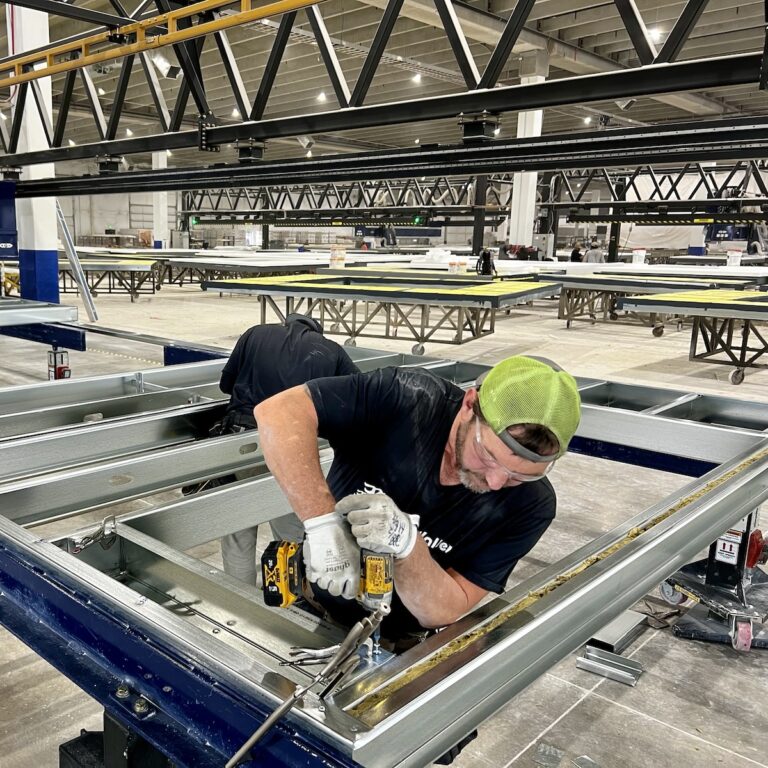
How Prefabricated CFS Panels Cut Multifamily Construction Schedules by 20%
How Factory Fabrication Enables Faster Multifamily Construction
Prefabricated cold-formed steel (CFS) panels reduce multifamily construction schedules by 20% or more by shifting structural framing from unpredictable job sites into controlled factory environments. CFS refers to steel shaped at room temperature per AISI S240 standards, then assembled into complete wall and floor panels before shipping to the project site.
Construction schedules on multifamily projects rarely go as planned — weather delays, labor shortages, and coordination problems compound floor by floor. Panelized CFS construction addresses all three variables simultaneously through parallel processing, weather-independent production, and reduced field labor requirements. SFIA publications document 50–60% framing phase reductions, with 20% overall project schedule compression representing a conservative, well-documented outcome.
Weather-Independent Manufacturing Eliminates Seasonal Delays
Factory fabrication proceeds indoors regardless of exterior conditions. Rain, snow, extreme cold — none of it stops CFS panel production. For New England projects subject to 780 CMR climate zone requirements, this advantage matters during six or more months when outdoor framing faces constant weather interruptions.
Traditional stick-built framing exposes materials and workers to the elements throughout the entire framing phase. CFS panels arrive on-site ready for immediate installation with no waiting for lumber to dry and no weather windows to chase.
Parallel Processing of Panel Fabrication and Site Work
Concurrent workflow represents the single largest schedule compression mechanism in panelized CFS construction. Panel fabrication runs simultaneously with site preparation rather than sequentially, compressing the critical path by weeks or months depending on project size.
| Traditional Stick-Built Sequence | Prefabricated CFS Sequence |
|---|---|
| Site prep, then foundation, then wait, then framing (sequential) | Site prep + panel fabrication in parallel, then rapid assembly |
| 100% of framing labor on-site | 60–70% of framing labor in factory |
| Weather-dependent timeline | Weather-independent production |
Reduced Field Labor Hours Through Pre-Assembly
Panels arrive with studs, tracks, headers, and openings already assembled using precision HOWICK machinery. Pre-assembly shifts 60–70% of framing labor hours from the field to the factory according to SFIA market data, reducing on-site crew requirements and coordination complexity.
Fewer trades working simultaneously on-site reduces coordination delays and site congestion. This benefit becomes especially significant on constrained urban infill sites common throughout the Boston metro area where staging space is limited.
Quantified Schedule Performance of Panelized Cold-Formed Steel Framing
BuildSteel.org case studies document consistent schedule improvements across multifamily projects using panelized CFS. A 7-story apartment project in Tucson completed framing in 78 days — roughly three months faster than conventional methods. Western Michigan University's Golden Oaks residence hall achieved 25% total construction time reduction using a prefabricated CFS and CLT hybrid design.
SFIA publications report that CFS load-bearing panelization typically reduces framing phase duration by 50–60% compared to stick-built approaches. The 20% overall project schedule reduction represents a conservative outcome achievable with proper planning and coordination.
Total Project Duration Savings
Schedule compression compounds across multi-story buildings. Each floor framed faster means earlier access for MEP rough-in, drywall, and finishes. On a five-story apartment building, CFS framing typically eliminates at least six weeks from the construction schedule versus podium-based wood approaches, according to BuildSteel.org documentation.
Framing Phase Compression Rates
RSMeans productivity data shows CFS panel installation rates significantly exceed stick-built wood framing on a square-foot-per-day basis. Since framing typically sits on the critical path, compressing this phase directly accelerates overall project completion and reduces carrying costs.
Some projects report saving up to 14 working days per floor through panelized CFS delivery. That is time your general conditions costs are not accruing and your construction loan is not accumulating interest.
Trade Sequencing and Coordination Improvements
Predictable panel arrival enables reliable MEP rough-in scheduling. When panels are fabricated from BIM models developed to LOD 400 (fabrication-ready detail level per AIA Document E203), penetrations and blocking locations are already coordinated before anything ships to the site.
This predictability cascades through subsequent trades. Electricians and plumbers can schedule their crews with confidence rather than waiting to see when framing will actually be complete — eliminating the schedule float that plagues stick-built projects.
Why Precision Engineering Ensures Reliable Schedule Performance
Dimensional accuracy per AISI S240 fabrication tolerances eliminates the field adjustments that cause delays on stick-built projects. CFS panels fabricated on HOWICK machinery achieve tolerances of plus-or-minus 1/8 inch, compared to plus-or-minus 1/4 to 3/8 inch typical for dimensional lumber cut in the field. Walls are plumb, floors are level, and connections align the first time.
HOWICK Machinery Fabrication Tolerances
HOWICK equipment produces CFS members with consistent, repeatable accuracy that hand-cutting cannot match. Every stud is the same length, every opening is precisely located, and every connection point aligns exactly with the design model. This consistency translates directly to faster assembly with fewer fit-up issues on the job site.
3D Model Verification Before Shipment
The CAD/BIM workflow catches problems digitally before fabrication begins. Load-bearing calculations using the AISI S100 Effective Width Method verify structural adequacy. Clash detection identifies MEP conflicts before they become field problems. By the time panels ship, the design has been thoroughly validated.
This front-loaded engineering investment pays dividends throughout construction. RFIs drop dramatically when the model is complete and accurate at LOD 400.
Pre-Shipment Quality Inspection Protocols
Factory QC checkpoints prevent defective panels from reaching the site. Inspectors verify dimensions, connections, and labeling before panels load onto trucks. This contrasts with stick-built construction where errors are often discovered only during field installation or municipal inspection — adding days or weeks of rework to the schedule.
Why Prefabricated CFS Outperforms Stick-Built and Wood Framing on Schedule
"Stick-built" refers to field-assembled construction where individual studs, tracks, and headers are cut and fastened on-site. While this approach offers flexibility, it introduces variability that extends schedules on every floor of a multi-story building.
- Field productivity: CFS panels require fewer labor hours per square foot than stick-framing per RSMeans productivity data
- Material handling: Labeled panels install in sequence versus sorting through lumber piles on-site
- Rework rates: Plus-or-minus 1/8 inch dimensional accuracy eliminates shimming and adjustment delays
- Learning curve: Repetitive panel installation builds crew efficiency faster than varied field conditions
Field Productivity Per Square Foot
RSMeans labor productivity data confirms the efficiency advantage of panelized CFS. Crews use screw guns rather than nail guns — a different technique that requires 2–3 days of specific training but delivers consistent, verifiable connections that meet IBC Section 1705.11 special inspection requirements.
Material Handling and Staging Efficiency
Each panel arrives labeled with its installation location and sequence number. Crews know exactly where every component goes without searching through material piles or deciphering field markings. Non-productive material handling time drops significantly.
Rework Elimination Through Dimensional Accuracy
When fabrication tolerances are plus-or-minus 1/8 inch, rework essentially disappears. Drywall installers find flat, plumb walls ready for finishing. Window installers find openings that match their units exactly. No shimming, no recutting, no callbacks — and no schedule delays from correction work.
Site Efficiency Gains from Just-in-Time Panel Delivery
Urban infill sites common throughout Massachusetts multifamily development often lack space for extensive material staging. Just-in-time CFS panel delivery means components arrive sequenced for immediate installation, minimizing laydown area requirements and site congestion.
Reduced Laydown Area for Urban Infill Sites
Tight Boston-area sites benefit enormously from panelized delivery. Rather than storing weeks of lumber on-site, panels arrive in the morning and are installed by afternoon. Site congestion drops and safety improves with less material to navigate around.
Sequenced Delivery Coordination
Delivery schedules align precisely with erection sequences. Panel identification systems ensure the right components arrive in the right order. This coordination requires upfront planning but eliminates the chaos of managing material flow on constrained urban sites.
Minimized Site Congestion and Safety Improvements
Fewer workers and less material staging reduces accident risk and improves daily productivity. OSHA recordable incident rates tend to be lower on panelized projects due to reduced site congestion and fewer on-site cutting operations.
How to Achieve Schedule Reduction with Prefabricated CFS Panels
1. Engage Fabricator During Design Development
Early involvement enables design-for-manufacturing optimization. The delegated design scope, where the CFS fabricator engineers the framing system per IBC requirements, works best when coordination begins before construction documents are complete.
2. Develop BIM Models to LOD 400 for Fabrication
Incomplete models cause RFIs and delays. LOD 400 represents fabrication-ready detail where every member, connection, and penetration is fully defined. Anything less creates gaps that slow production and generate field changes.
3. Coordinate Delivery Sequence with Erection Plan
Logistics coordination determines whether panels arrive ready for immediate installation or create site congestion. Panel identification systems and staging plans require advance planning but pay off in smooth field operations.
4. Train Field Crews on Screw Gun Assembly Techniques
CFS installation differs from wood framing. Crews typically require 2–3 days of training to achieve full productivity with screw gun techniques and panel handling procedures. This training investment pays back immediately in installation speed.
5. Integrate Quality Control Checkpoints with Inspection Schedule
IBC Section 1705.11 requires special inspections for CFS structural framing. Pre-planned inspection schedules prevent delays from failed inspections or inspector availability conflicts.
Schedule-Driven Cost Savings from Prefabricated CFS Construction
Faster schedules translate directly to financial outcomes beyond labor savings. Every month eliminated from the construction timeline reduces carrying costs, accelerates revenue, and compresses overhead expenses.
Construction Loan Carrying Cost Reduction
Shorter schedules reduce interest accrual on construction financing. On typical multifamily projects, carrying costs run $15,000–$25,000 per month depending on project size and loan terms. A 20% schedule compression on an 18-month project saves 3–4 months of carrying costs.
Earlier Tenant Occupancy and Revenue Generation
Faster completion enables earlier rent collection. For developers, this accelerated revenue stream improves ROI calculations significantly, especially on larger projects where monthly rent rolls are substantial.
Reduced General Conditions and Supervision Duration
Per RSMeans general conditions categories, shorter projects require fewer months of superintendent, trailer, utilities, and site overhead costs. Every month saved is a month of general conditions expense eliminated from the project budget.
Coordination Requirements and Risk Mitigation for Panelized CFS
Schedule benefits require upfront coordination investment. Changes after fabrication begins cause delays and costs that can exceed the schedule savings if not properly managed.
Design Freeze Requirements for Fabrication
The design freeze milestone typically occurs 8–12 weeks before panel delivery. After this point, changes require panel modifications or refabrication, both of which compromise the schedule advantages of panelized construction.
Supply Chain Lead Time Planning
Current CFS supply lead times vary by market conditions and fabricator capacity. Verify lead times early in project planning rather than assuming availability. Market conditions change, and assumptions made during feasibility may not hold at procurement.
MEP Rough-In Coordination with Panel Sequencing
Penetrations and blocking locations are fixed once panels are fabricated. BIM clash detection workflows per LOD 400 requirements catch conflicts before they become field problems. Skipping this coordination step guarantees delays later in construction.
FAQs About Prefabricated CFS Panel Construction Schedules
How far in advance do prefabricated CFS panels need to be ordered?
Lead times typically range from 8–16 weeks depending on project complexity and fabricator capacity. Current market conditions affect availability, so confirm lead times during design development rather than assuming standard timelines.
What crew size is required to install panelized CFS compared to stick-built wood framing?
Panelized CFS typically requires smaller crews with different skill sets. Expect 3–5 installers per crew versus 6–8 for comparable stick-built production. Specific crew sizing depends on panel weights, crane availability, and building configuration.
Can prefabricated CFS panels be modified on-site if field conditions require changes?
Minor modifications are possible with appropriate tools, though significant changes defeat the purpose of prefabrication. Thorough pre-fabrication coordination and BIM verification at LOD 400 prevent most field modification needs.
How does winter weather affect prefabricated CFS panel installation in New England?
CFS installation can proceed in cold weather since steel requires no curing time. Site access and crane operation may still face severe weather limitations, but the framing work itself is less weather-sensitive than wood construction or concrete podium pours that require cold-weather protection per 780 CMR provisions.
What special inspections does IBC require for prefabricated CFS framing?
IBC Section 1705.11 requires special inspections for cold-formed steel structural framing. Scope depends on structural classification and local jurisdiction requirements, including any 780 CMR amendments applicable to Massachusetts projects.
Ready to compress your next multifamily construction schedule by 20% or more? AAC Steel Engineering delivers precision-fabricated CFS panels using HOWICK machinery and advanced CAD/3D modeling, optimized for rapid assembly on Massachusetts and New England projects. Contact AAC Steel Engineering for project-specific feasibility analysis.