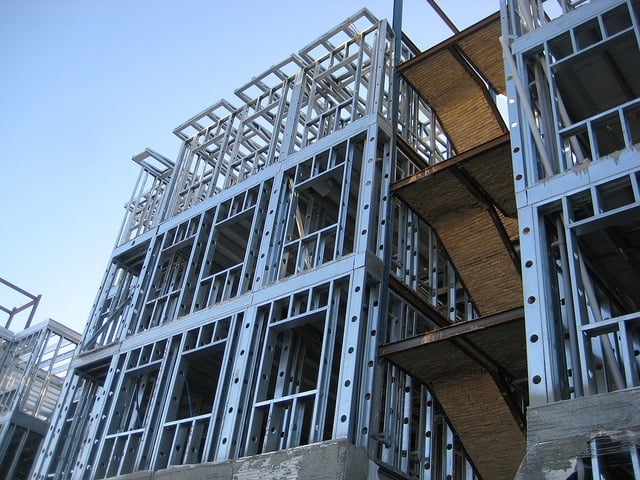
Eliminating Type IA Podium Construction with Cold-Formed Steel
How Cold-Formed Steel Eliminates Type IA Podium Requirements Under IBC
Cold-formed steel (CFS) framing eliminates the need for expensive Type IA concrete podium construction in mid-rise multifamily buildings. CFS qualifies as non-combustible per ASTM E136, which places it in the same IBC classification category as concrete and structural steel under Table 601 and Table 602. This means the entire structure — from foundation to roof — can be built without pouring a concrete podium base.
A concrete podium under a mid-rise building adds $12–15/SF to construction cost and 8–12 weeks to the schedule. These expenses exist solely because wood framing is combustible and requires a non-combustible base for taller structures under IBC. At six stories, CFS saves approximately $13.42/SF compared to wood-over-podium construction; at seven stories, that differential increases to $21.11/SF (RSMeans 2024, Boston market basis per BuildSteel.org case study data).
- Non-combustible classification: CFS meets ASTM E136 requirements, qualifying for Type IIA or Type IIB construction under IBC Section 602.2
- Podium elimination: Full-height CFS framing removes the code trigger that mandates concrete podium construction for mid-rise buildings
- Height flexibility: Type II construction permits greater allowable height than Type IIIA or Type VA wood construction per IBC Tables 504.3 and 504.4
IBC Construction Type Classifications for Mid-Rise CFS Buildings
The IBC distinguishes construction types by two factors: material combustibility and fire-resistance ratings. Understanding where CFS fits in this framework clarifies why podium elimination works and which UL-listed fire-rated assemblies apply to different project configurations.
Type IIB Non-Combustible CFS Construction
Type IIB is non-combustible construction with no fire-resistance rating requirements for the structural frame. Per IBC Table 601, the structural frame, bearing walls, and floor construction all carry 0-hour rating requirements. This classification works well for fully sprinklered multifamily buildings where the automatic sprinkler system per NFPA 13 provides primary fire protection.
Type IIA Non-Combustible CFS Construction with 1-Hour Rating
Type IIA requires a 1-hour fire-resistance rating on the structural frame per IBC Table 601. CFS assemblies achieve this rating through gypsum board layers applied per specific UL-listed designs. UL assemblies in the U400 and U500 series provide compliant wall ratings, while L500 and G500 series assemblies address floor-ceiling requirements. Each UL listing specifies exact layer counts, screw spacing, and installation parameters that must be followed precisely.
Height and Area Allowances per IBC Tables 504.3 and 504.4
Type IIA and IIB construction permits greater height and area than Type IIIA or Type VA wood construction. Sprinkler increases per IBC Section 504.2 apply to both material types, but CFS starts from a higher baseline allowance — the key advantage that eliminates podium requirements.
| Construction Type | Primary Material | Podium Required for 5+ Stories |
|---|---|---|
| Type VA (wood) | Combustible | Yes |
| Type IIIA (wood) | Combustible | Yes |
| Type IIB (CFS) | Non-combustible (ASTM E136) | No |
| Type IIA (CFS) | Non-combustible (ASTM E136) | No |
Cost Comparison: CFS vs. Wood-Over-Podium by Building Height
The cost crossover between CFS and wood-over-podium construction follows a predictable pattern as building height increases. At lower heights, wood maintains a material cost advantage. As buildings reach five stories and above, podium requirements and fire-retardant treated (FRT) lumber costs shift the economics decisively toward CFS.
Material pricing fluctuates, so the figures below from SFIA studies and BuildSteel.org case studies (RSMeans 2024, Boston market) warrant project-specific verification.
4-Story Buildings: Wood Framing Maintains Cost Advantage
At four stories, wood framing typically does not require podium construction or FRT lumber. Wood's material cost advantage — roughly $14.50–16.50/SF versus $24.00–26.00/SF for CFS framing per SFIA data — remains intact at this height. However, lifecycle factors like insurance savings (up to 38.2% over 30 years per SFIA) and reduced maintenance narrow the gap when considered over the building's useful life.
5-Story Buildings: CFS Reaches Cost Parity
Five stories represents the decision threshold where CFS economics become competitive. Wood projects at this height typically require either podium construction or FRT lumber to meet IBC requirements. FRT lumber carries a 10–25% structural capacity reduction requiring larger members, plus stainless steel fasteners adding $0.25–0.40/SF per BuildSteel.org technical resources. CFS maintains consistent pricing regardless of building height.
6–7 Story Buildings: CFS Delivers Maximum Savings
At six and seven stories, the podium itself — concrete structure, reinforcing steel, formwork, extended foundations, and curing time — drives wood-over-podium costs upward while CFS framing costs remain stable. The concrete podium adds both direct construction cost and schedule time that translates to significant carrying cost increases.
- Podium construction cost: Concrete, reinforcing steel, formwork, and extended foundation requirements add $12–15/SF in direct first cost per RSMeans 2024
- FRT lumber premium: Fire-retardant treatment increases lumber cost 15–30% and reduces structural capacity 10–25%, requiring larger members
- Schedule carrying costs: Extended construction timelines increase financing at $15,000–25,000/month, general conditions, and opportunity costs
Schedule Comparison: CFS Prefabrication vs. Concrete Podium Construction
Schedule advantages translate directly to financial benefits beyond line-item framing costs. Eliminating the podium phase alone saves 8–12 weeks. Combined with faster CFS panel erection, total schedule compression can reach 20% or more on mid-rise projects.
Concrete Podium Construction Timeline
Podium construction follows a sequential process: excavation, foundation work, concrete pours, and curing time. Each phase depends on the previous one completing before the next can begin. In New England, 780 CMR cold weather concrete provisions add further complexity — winter pours require heating, insulation, and extended cure monitoring that do not apply to CFS panel erection.
CFS Panelization and Factory-Controlled Fabrication
CFS panels fabricate in a controlled factory environment while site work proceeds simultaneously. Using HOWICK machinery and CAD/3D modeling, complete framed layouts and load-bearing calculations per AISI S100 are verified before fabrication begins. Panels arrive at the site ready for erection, reducing field labor hours and eliminating weather-related fabrication delays.
This parallel-path approach means site preparation and panel fabrication happen at the same time rather than in sequence — compressing the critical path by the full duration of what would have been the podium construction phase.
Total Project Duration Reduction
The cumulative schedule benefit compounds: no podium construction phase plus faster framing erection. SFIA data and BuildSteel.org case studies document 50–60% framing time reductions with panelized CFS compared to stick-built approaches.
- Parallel path construction: CFS fabrication proceeds while site preparation occurs simultaneously
- Weather independence: Factory manufacturing eliminates weather-related fabrication delays year-round
- No cure time: Eliminating concrete curing delays removes a major schedule constraint from the critical path
Fire-Rated CFS Assemblies That Enable Podium Elimination
Achieving non-combustible classification for the full building height requires specific tested assemblies from the UL Fire Resistance Directory. Assembly selection depends on project-specific fire-resistance rating requirements per IBC Table 601.
UL floor-ceiling assemblies in the L500 and G500 series provide 1-hour and 2-hour ratings for CFS joist construction. A typical assembly includes CFS joists at 16" or 24" spacing, multiple layers of 5/8" Type X gypsum board, and structural deck products. Each UL listing specifies exact screw type, spacing, and resilient channel requirements — compliance requires following the listing details precisely.
Wall assemblies in the U400 and U500 series address load-bearing and non-load-bearing partitions. UL Design H514 provides 1-hour and 2-hour ratings for load-bearing CFS walls with specific gypsum board configurations and fastener patterns.
Penetrations through fire-rated assemblies require listed firestop systems tested per ASTM E814 and UL 1479. Firestop selection depends on both the assembly type and the penetrating item — generic fire caulk does not qualify as a listed system.
Special inspection per IBC Section 1705.11 may be required for CFS framing in seismic force-resisting systems. Verifying inspection requirements with the registered design professional early in the project avoids surprises during construction.
Lifecycle Cost Advantages of Non-Combustible CFS Construction
First-cost comparisons tell only part of the story. Insurance premiums, maintenance requirements, and structural durability differentiate CFS from wood construction over the building's 30+ year useful life.
Non-combustible construction classification per ASTM E136 typically results in 15–30% lower annual property insurance premiums because insurers assess fire risk based on construction type. SFIA data documents potential cumulative insurance savings up to 38.2% over a 30-year lifecycle. On larger projects, cumulative insurance savings can exceed $1 million.
CFS eliminates rot, termite damage, and warping that affect wood structures over time. Steel maintains dimensional stability without seasonal movement or settling — the same tolerances that existed at installation remain decades later.
- Insurance premiums: Non-combustible classification reduces fire risk assessment, saving 15–30% annually on property insurance
- Structural maintenance: CFS eliminates rot, pest, and moisture-related repair costs common with wood framing
- Dimensional stability: CFS maintains precise fabrication tolerances (plus-or-minus 1/8 inch) without seasonal movement or settling
Project Evaluation Criteria: CFS vs. Podium Construction
Not every project benefits equally from CFS construction. Building height, site constraints, schedule requirements, and ownership structure all influence whether CFS or wood-over-podium delivers the best project economics.
- Building height: Projects at 5+ stories reach cost parity or CFS advantage threshold based on SFIA and BuildSteel.org data
- Site constraints: Limited site access or urban infill sites benefit from prefabrication logistics and reduced on-site material staging
- Schedule requirements: Compressed timelines favor factory-controlled fabrication and parallel-path construction sequencing
- Lifecycle priorities: Owner-occupied or long-term hold projects benefit most from 30-year lifecycle cost analysis including insurance and maintenance savings
- Regional factors: Massachusetts 780 CMR amendments and stretch energy code compliance (HERS index requirements for mixed-fuel and all-electric buildings) affect material selection and assembly design
FAQs About Eliminating Podium Construction with Cold-Formed Steel
Can a project originally designed with podium construction be redesigned to use full-height CFS framing?
Yes, though redesign requires structural engineering analysis per AISI S100 and S240, updated IBC code review for construction type reclassification, and revised construction documents. Early evaluation during schematic design provides the most flexibility and cost-effectiveness. Changes become progressively more expensive as design development advances.
What is the typical fabrication lead time for prefabricated CFS panels?
CFS panel fabrication typically requires 8–16 weeks from approved shop drawings to delivery depending on project complexity and fabricator capacity. The parallel-path advantage — fabrication occurring during site preparation — often provides net schedule benefit compared to sequential podium construction phases.
Do lenders and insurers provide favorable terms for non-combustible CFS buildings?
Many insurers offer 15–30% reduced annual premiums for non-combustible construction due to lower fire risk classification per ASTM E136. Some lenders recognize the reduced risk profile in underwriting. Specific terms vary by insurer, lender, and project characteristics. Early conversations with insurance brokers help quantify potential savings for a specific project.
Evaluating podium elimination for your next mid-rise multifamily project? AAC Steel Engineering provides complete design-assist services including IBC construction type analysis, 3D modeling, AISI-based load-bearing calculations, and prefabricated CFS panel fabrication using HOWICK machinery for projects throughout Massachusetts and New England. Contact AAC Steel Engineering for project-specific feasibility analysis.