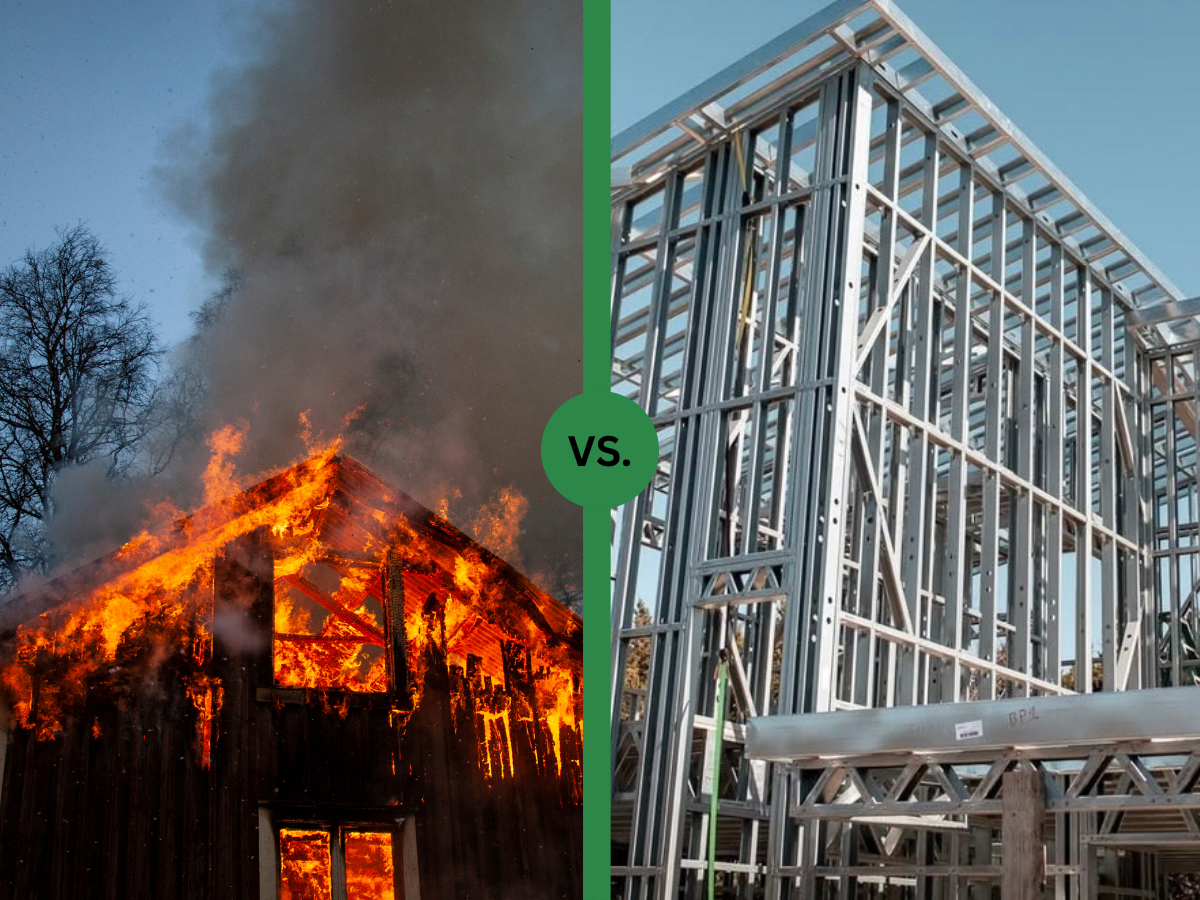
Fire Safety Advantages of Cold-Formed Steel Structures
Non-Combustible Classification of Cold-Formed Steel per ASTM E136
Cold-formed steel (CFS) provides superior fire safety compared to wood framing because steel does not burn. Wood ignites at temperatures between 400–500°F, while steel has a melting point around 2,700°F. Most building fires reach 1,000–1,800°F—temperatures at which CFS framing remains structurally intact while wood actively feeds the flames.
The International Building Code relies on ASTM E136 to classify materials as combustible or non-combustible. This test exposes materials to furnace temperatures of 1,382°F and measures whether they ignite, burn, or release flammable vapors. CFS passes without any chemical treatment—it simply cannot burn.
Fire-retardant treated (FRT) lumber works differently. Chemical treatments slow flame spread, but the wood itself remains combustible. The treatment buys time; it does not change the fundamental material classification. This distinction drives how the IBC classifies construction types and determines what buildings each material can construct.
- ASTM E136: The standard test method determining if materials contribute to fire growth
- Non-combustible classification: Materials that do not ignite, burn, or release flammable vapors under test conditions
- Fire-retardant treated lumber: Chemically treated wood that slows flame spread but remains classified as combustible under IBC
Fire Performance Comparison Between CFS and Wood Framing
Flame Spread and Fire Behavior Characteristics
When fire reaches CFS framing, the steel does not add fuel to the fire event. Wood framing does the opposite—it actively contributes combustible mass that intensifies the blaze.
ASTM E84 measures flame spread index and smoke development for building materials. CFS achieves a Class A flame spread rating (the highest classification, index 0–25) because steel produces zero flame spread. Wood framing, even with fire-retardant treatment, still generates measurable flame spread and smoke during fire exposure.
Structural Integrity Under Fire Loading per ASTM E119
ASTM E119 tests how long building assemblies maintain structural function and prevent fire passage under controlled conditions. CFS assemblies with proper gypsum board protection—such as UL Design H514 or H505—maintain load-bearing capacity for the full rated duration.
Wood framing loses capacity progressively as it chars at approximately 1.5 inches per hour, reducing cross-sectional area and strength throughout fire exposure. Protected CFS assemblies do not experience this gradual degradation mechanism.
Post-Fire Damage Assessment and Recovery
CFS frames frequently retain structural integrity for repair and reuse after fire events. The steel members, protected by gypsum board layers during the fire, often remain structurally sound once engineers complete post-fire assessment.
Wood framing typically requires complete demolition after significant fire exposure. Char damage compromises connections, and even members that appear intact may have hidden structural deficiencies. This difference affects insurance claims, rebuild timelines, and whether a building is classified as a total loss.
Fire-Rated Assembly Specifications for CFS Construction
Load-Bearing Wall Assemblies: UL Design H505 and H514
UL-listed fire-rated assemblies provide the tested, code-compliant path for CFS construction. These are the primary UL designs for CFS load-bearing walls:
| UL Design | Fire Rating | Key Requirements |
|---|---|---|
| H505 | 1-hour | Two layers 5/8" Type X gypsum, #6 Type S screws @ 12" o.c. field |
| H514 | 2-hour | Three layers 5/8" Type X gypsum, 20-gauge studs @ 24" o.c. |
Both assemblies are tested per ASTM E119. Gypsum type, screw spacing, and stud gauge are critical parameters—deviating from the listed specifications voids the fire rating.
Floor-Ceiling Assemblies: UL Design L541 and G602
Horizontal fire separation between floors requires tested floor-ceiling assemblies. UL Design L541 provides 1-hour and 2-hour options depending on configuration. UL Design G602 offers additional options for specific joist depths and ceiling configurations.
Resilient channel requirements are critical for achieving listed ratings. Most assemblies require 25-gauge resilient channels at 16" o.c. The ceiling membrane provides primary fire protection for the CFS joists above.
Firestop Systems per ASTM E814 and UL 1479
Fire-rated assemblies are only as effective as their weakest point. Pipes, conduits, and ducts passing through fire-rated assemblies require listed firestop systems to maintain compartmentalization.
ASTM E814 governs through-penetration fire tests. UL 1479 certifies specific firestop products for specific penetration types. Specifying "firestop as required" is not sufficient—the firestop system must be listed for the specific penetration type and assembly configuration.
IBC Construction Type Analysis for Non-Combustible CFS Framing
Type IIA and IIB Fire Resistance Requirements per IBC Table 601
CFS's non-combustible classification per ASTM E136 enables Type II construction under the IBC. Per Table 601, the construction types compare as follows:
| Construction Type | Structural Frame | Bearing Walls | Framing Material |
|---|---|---|---|
| Type IIA | 1-hour | 1-hour | Non-combustible required |
| Type IIB | 0-hour | 0-hour | Non-combustible required |
| Type IIIA | 1-hour | 1-hour | Combustible permitted |
| Type VA | 1-hour | 1-hour | Combustible permitted |
Types IIIA and VA permit combustible framing materials. Type II requires non-combustible materials throughout, which CFS provides inherently without additional chemical treatment.
Height and Area Allowances per IBC Tables 504.3 and 504.4
Construction type directly affects permissible building height and area. Per IBC Tables 504.3 and 504.4, Type IIB CFS buildings receive greater height and area allowances than Type IIIA or VA wood-framed buildings for most occupancy types.
Automatic sprinkler systems provide additional increases per IBC Section 504.2, typically one additional story and significant area increases. Combined with CFS's non-combustible classification, this creates substantial design flexibility for mid-rise multi-family projects.
Eliminating Podium Construction for Five-Plus Story Buildings
This is where fire safety connects directly to project economics. Wood-framed buildings over four stories typically require a concrete podium—a Type IA base structure—per IBC Section 510.2 horizontal building separation provisions.
CFS enables full-height non-combustible construction without a podium. Per RSMeans 2024 data for the Boston market, podium elimination saves $12–15/SF in construction cost plus 8–12 weeks of schedule. For a typical five-story multi-family project, that translates to over $730,000 in combined savings.
Insurance Premium and Lifecycle Cost Advantages
Premium Differentials: Non-Combustible vs. Combustible Construction
Insurance underwriters classify buildings by construction type, and non-combustible construction consistently receives more favorable rates. CFS typically qualifies for ISO Class 4 (masonry non-combustible) versus wood's ISO Class 1 (frame construction).
Per BuildSteel.org case studies, builder's risk insurance premiums for CFS construction can be 25–75% lower than comparable wood-framed projects. Premium differentials compound over the building's lifecycle, making the total cost difference substantial over 20–30 years of ownership.
Thirty-Year Lifecycle Cost Analysis
Cumulative insurance savings over a 30-year building lifecycle can reach 38.2%, potentially exceeding $1 million for larger multi-family projects, per SFIA market data. For a 68,498 SF residential building, BuildSteel.org documents approximately $666,000 in insurance savings over 30 years using a 4% discount rate.
Project-specific analysis is essential for accurate lifecycle cost projections. RSMeans 2024 provides baseline data, though material pricing volatility may affect current estimates.
Construction-Phase Fire Risk Comparison
Unprotected Framing Exposure During Construction
During framing, structures lack the gypsum protection that provides fire ratings. This creates a vulnerability window where material choice has significant safety implications.
Wood framing is fully combustible during construction. The November 2024 UMass Amherst fire demonstrated this risk: a wood-framed building under construction experienced total structural loss within 30 minutes, displacing 232 students. CFS remains non-combustible per ASTM E136 throughout construction, even before fire-rated assemblies are complete.
Documented Fire Outcomes: Wood vs. CFS Construction
BuildSteel.org has documented multiple cases where CFS buildings survived fires that destroyed adjacent wood structures. In Southern California wildfire events, CFS-framed homes remained standing while neighboring wood-framed structures were lost.
Non-combustibility provides inherent protection even without active suppression. The CFS structure does not contribute fuel to the fire event, limiting damage even when fires occur.
Code and Standards Compliance for CFS Fire-Resistant Design
AISI S100 and S240 Structural Design Provisions
CFS structural design is governed by AISI S100 (North American Specification for the Design of Cold-Formed Steel Structural Members) and AISI S240 (North American Standard for Cold-Formed Steel Structural Framing). Both standards are adopted by reference in the IBC and address member design, connection engineering, and system behavior.
Massachusetts 780 CMR Amendments
For projects in Massachusetts, 780 CMR adopts the IBC with state-specific amendments. Fire resistance requirements generally follow the base IBC, though local Authority Having Jurisdiction interpretation may affect specific project requirements.
Massachusetts stretch energy code requirements (HERS rating no greater than 42 mixed-fuel, no greater than 45 all-electric) interact with assembly design. Continuous insulation strategies for energy compliance can be coordinated with fire-rated assembly specifications to meet both performance targets simultaneously.
Frequently Asked Questions About Cold-Formed Steel Fire Safety
What are the structural limitations of cold-formed steel at high temperatures?
CFS members lose yield strength as temperature increases, which is why fire-rated assemblies use gypsum board layers to insulate the steel per UL-listed designs such as H505 and H514. The assembly prevents members from reaching critical temperatures during the rated fire duration. Proper assembly design per ASTM E119 testing accounts for temperature effects on steel strength.
How do CFS fire ratings compare to fire-retardant treated lumber ratings?
CFS assemblies achieve fire ratings through tested UL designs with specific gypsum configurations. FRT lumber still requires fire-rated assembly construction and remains classified as combustible under ASTM E136. The chemical treatment slows flame spread but does not eliminate burning or change the material's combustible classification under the IBC.
What special inspections does IBC require for CFS fire-rated assemblies?
IBC Section 1705.11 requires special inspection of CFS framing for structural members. Fire-rated assembly construction requires verification that materials, fasteners, and installation match the specified UL design number exactly. Deviations from listed specifications void the fire rating.
How does cold-formed steel fire performance affect building insurance classifications?
Insurance underwriters classify CFS buildings as non-combustible construction, typically ISO Class 4 or better. This classification generally results in 25–75% lower premiums than combustible wood-framed buildings classified as ISO Class 1 frame construction, per BuildSteel.org data. Premium differentials vary by carrier and project specifics.
Engineer Fire-Resistant Multi-Family Construction with Confidence. AAC Steel's precision engineering approach uses HOWICK machinery and CAD/3D modeling to fabricate fire-rated assemblies to exact UL design specifications—every component engineered and validated before it ships to the job site. Contact AAC Steel Engineering for project-specific fire safety analysis and construction type optimization.