AAC STEEL
How Prefabricated CFS Panels Cut Multifamily Construction Schedules by 20%
Schedule & Labor Optimization for GC Project Managers
www.aacsteel.com
How Prefabricated CFS Panels Cut Multifamily Construction Schedules by 20%
Executive Summary
Prefabricated cold-formed steel (CFS) panel systems reduce on-site framing time by up to 20% compared to conventional wood stick framing — translating to weeks saved per floor on mid-rise multifamily projects. For a 5-story, 120-unit building, that schedule compression can mean four to six weeks removed from the overall construction timeline, with direct savings in carrying costs, general conditions, and accelerated revenue from earlier occupancy.
The construction industry is confronting a structural labor crisis. According to the Bureau of Labor Statistics (BLS) and the Associated Builders and Contractors (ABC), the construction sector needs to attract an estimated 501,000 additional workers in 2024 alone on top of normal hiring to meet demand. Skilled framing crews — the tradespeople who build the structural skeleton of every multifamily project — are among the hardest positions to fill. Wage inflation in the framing trades has outpaced general construction labor by 8–12% annually in key metro markets, and crew availability increasingly dictates project start dates rather than permitting or financing timelines.
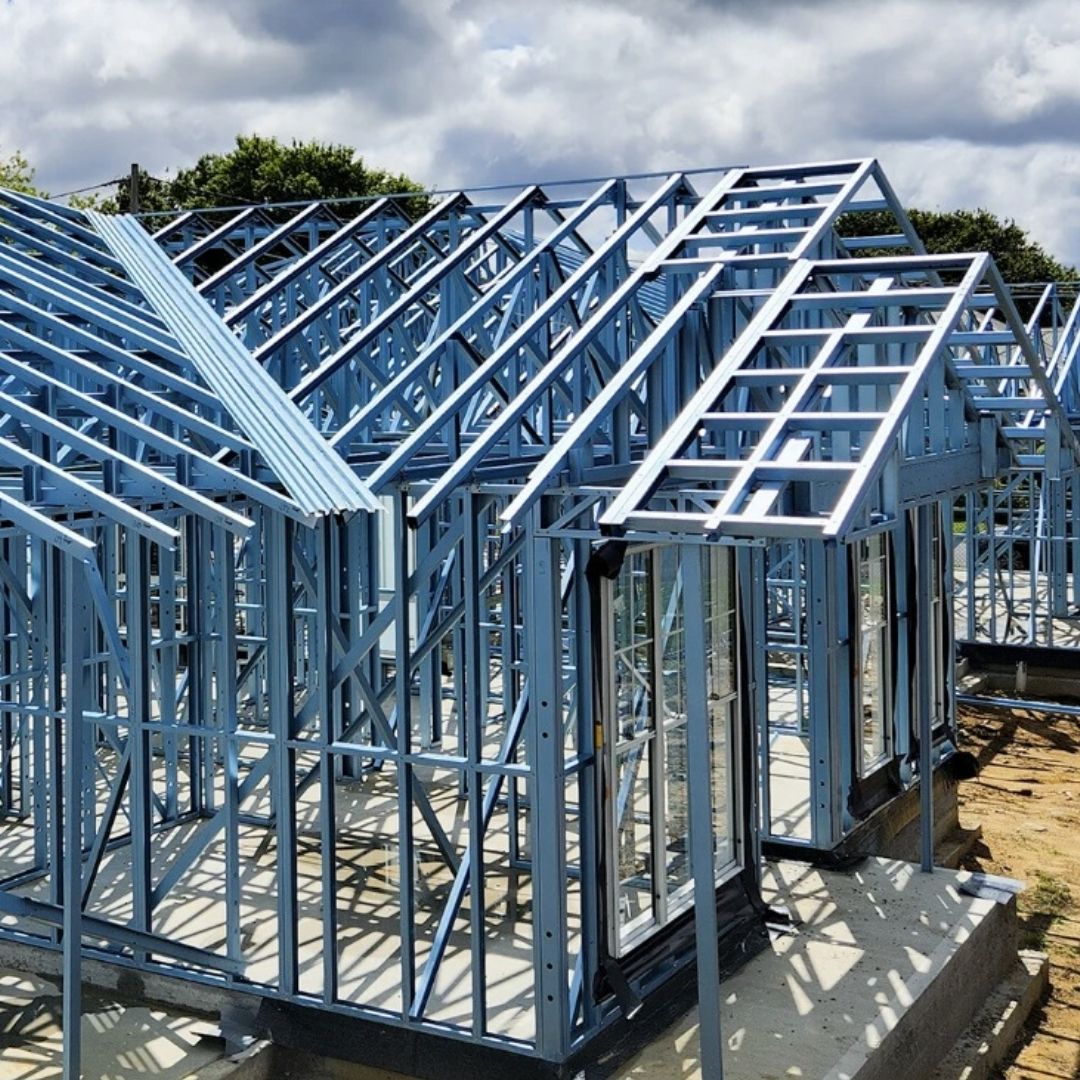
Panelized cold-formed steel (CFS) delivery fundamentally changes the framing sequence. Instead of field-measuring, cutting, and assembling individual members on-site — the defining workflow of stick framing — CFS panels arrive factory-fabricated to exact dimensions, pre-punched for utilities, and sequenced for installation order. The result is a framing process that behaves more like assembly than construction, compressing timelines, reducing crew sizes, and eliminating categories of on-site risk that have plagued wood-framed multifamily schedules for decades.
The Problem: Why Stick Framing Can't Keep Up
The Construction Labor Crisis
The numbers are stark. The U.S. construction industry lost over 1 million workers during the 2008–2010 recession, and workforce participation in the skilled trades has never fully recovered. BLS data shows that the median age of a construction worker continues to rise, with fewer entrants from vocational programs replacing retiring tradespeople. The National Association of Home Builders (NAHB) reports that 90% of builders cite labor availability as their top challenge — ahead of material costs, regulatory burden, and lot availability.
For general contractors managing mid-rise multifamily projects, this shortage is not an abstract workforce statistic. It manifests as framing subcontractor bids arriving 30–45 days late, crews cycling between competing projects, and schedule commitments that slip before a single stud is set. When your framing crew is stretched across three jobsites, your 5-story building is the one that waits.
The Compounding Cost of Schedule Delays
Schedule delays in multifamily construction carry costs that extend far beyond the framing line item. Consider a mid-rise project with $18 million in construction financing at a 7.5% annual interest rate. Every month of delay adds approximately $112,500 in interest carry alone. Layer on general conditions — superintendent salary, equipment rental, temporary utilities, insurance, and site security — and monthly carrying costs can reach $150,000–$200,000 for a project of this scale. Add lost rental income from delayed occupancy (120 units at an average $2,200/month represents $264,000 in deferred revenue per month), and the true cost of a one-month schedule slip can exceed $400,000.
Stick-Built Wood Framing: Structural Limitations
Conventional wood stick framing carries inherent vulnerabilities that make schedule certainty difficult to guarantee. Dimensional lumber is sensitive to moisture — framing-grade SPF (spruce-pine-fir) can absorb moisture rapidly in rain events, leading to swelling, warping, and the need for drying time before enclosure. Field-cut wood framing relies on skilled carpenters measuring, cutting, and fitting each member individually, introducing variability at every connection. And dimensional lumber itself varies: a nominal 2×6 from different mills, different species, or even different lifts within the same delivery can vary by 1/8" or more in actual dimension, creating cumulative tolerance issues across a 60-foot exterior wall.
The Math on a Typical Project
Industry benchmarks from the National Multifamily Housing Council (NMHC) and RSMeans construction data indicate that conventional wood stick framing for a 5-story, 120-unit multifamily building typically requires 14–18 working days per floor for framing alone, depending on unit mix complexity, exterior articulation, and crew size. A full framing cycle for five stories therefore ranges from 70–90 working days (14–18 weeks) under ideal conditions. Factor in weather delays, material delivery gaps, and crew availability interruptions, and actual schedules often extend to 20–24 weeks.
Adding more crew members does not scale linearly. Trade stacking — placing too many workers in the same area simultaneously — creates diminishing returns. Studies from the Construction Industry Institute (CII) demonstrate that productivity losses from trade stacking can reach 20–30% when crew density exceeds optimal thresholds. More bodies on-site does not mean faster framing; it often means more coordination overhead, more safety risk, and more rework.
How Panelized CFS Delivery Works
AAC Steel's prefabricated cold-formed steel (CFS) panel system replaces the traditional field-framing workflow with a factory-controlled manufacturing and sequenced delivery process. Every panel that arrives on-site has been engineered, fabricated, and verified before it leaves our facility. The process follows five integrated steps.
Step 1: Detailed 3D BIM Modeling
Every project begins with comprehensive 3D Building Information Modeling (BIM). Our engineering team creates complete framed layouts — every stud, track, header, jamb, and connection — in a digital model before any steel is formed. This model serves as the single source of truth for the entire framing package. Clash detection runs identify conflicts with MEP (mechanical, electrical, plumbing) routing before fabrication, eliminating the field-coordination delays that routinely disrupt stick framing schedules. The BIM model also generates precise material takeoffs, ensuring zero waste from over-ordering and zero delays from under-ordering.
Step 2: Factory-Controlled Manufacturing
AAC Steel utilizes HOWICK roll-forming machinery — the industry standard for precision CFS fabrication. HOWICK equipment delivers dimensional tolerances within 1/16" (1.5 mm) consistently across every member. Steel coils are fed into the roll-former, and the machine produces studs, tracks, and specialty members to exact lengths with pre-punched utility knockouts, web stiffeners, and connection holes — all controlled by the digital model from Step 1. There is no hand-measuring, no field cutting, and no dimensional variability from operator to operator. Factory conditions mean no weather interference during fabrication, no material degradation from site storage, and consistent quality shift after shift.
Step 3: Structural Verification on Digital Models
Before any panel ships, load-bearing calculations are verified against the digital model. Every element of structural integrity — axial loads, lateral bracing, shear transfer, connection capacity — is confirmed in the engineering model per AISI S100 (North American Specification for the Design of Cold-Formed Steel Structural Members) and AISI S240 (North American Standard for Cold-Formed Steel Structural Framing). This pre-verification eliminates the structural uncertainties that can arise with field-framed wood assemblies, where load path integrity depends on individual carpenter judgment at every connection.
Step 4: Coordinated Delivery Schedules
Panels are not simply shipped to the jobsite in bulk. AAC Steel coordinates delivery schedules so that panels arrive sequenced for installation order — floor by floor, elevation by elevation. This just-in-time delivery approach minimizes on-site staging area requirements (critical for urban infill sites with limited laydown space), reduces material handling and double-moves, and ensures that the installation crew always has the next panel ready without waiting for deliveries or searching through stacked inventory. Each panel is labeled with a unique identifier that maps directly to the BIM model and installation drawing.
Step 5: On-Site Assembly
On-site, prefabricated CFS panels are set, plumbed, and fastened using the installation drawings generated from the BIM model. Because every panel is fabricated to exact dimensions with pre-located connections, the installation process requires significantly fewer on-site adjustments than stick framing. Panels are secured with standard CFS fasteners (self-drilling screws per AISI specifications), and the predictable geometry means that follow-on trades — electrical, plumbing, HVAC, insulation — can begin their rough-in work on completed floors while framing continues above. This overlap is one of the most significant schedule advantages of panelized CFS delivery.
The Precision Advantage
The contrast between panelized CFS and stick-built wood framing is a contrast between manufactured precision and field variability. CFS panels fabricated on HOWICK machinery hold tolerances within 1/16" across every member and every panel. Wood stick framing introduces variability at multiple points: lumber dimensional variation, moisture-driven movement, field-cut accuracy, and assembly alignment. The cumulative effect of these variables means that a stick-framed wall may be 1/4" to 1/2" out of plumb or plane over an 8-foot height — a deviation that cascades into drywall fitting, cabinet installation, and finish carpentry adjustments. CFS panels arrive plumb and square from the factory. Installation is closer to assembly than construction — fewer specialized skills required, fewer field decisions, and fewer opportunities for error.
Schedule Savings Breakdown
A 20% reduction in framing schedule is not a marketing estimate — it is a measurable outcome documented across panelized CFS projects nationally. Data from BuildSteel.org and the Steel Framing Industry Association (SFIA) consistently shows that prefabricated CFS panel systems reduce on-site framing durations by 15–25% compared to conventional wood stick framing on comparable multifamily projects.
Timeline Comparison: 5-Story, 120-Unit Multifamily Project
Baseline — Wood Stick Framing: Industry data (RSMeans, NMHC benchmarks) indicates a typical floor-to-floor framing cycle of 14–18 working days for conventional wood stick framing on a mid-rise multifamily building of this scale. Over five stories, total framing duration under ideal conditions ranges from 70–90 working days. With typical weather delays, material gaps, and crew interruptions factored in, actual project framing timelines commonly extend to 90–110 working days (18–22 weeks).
Panelized CFS — AAC Steel System: Prefabricated CFS panel installation reduces the floor-to-floor cycle to 10–14 working days per floor. Over five stories, total framing duration compresses to 50–70 working days. With the weather independence and delivery predictability inherent in the panelized approach, actual project framing timelines consistently fall within 55–75 working days (11–15 weeks).
Net Savings: 20–35 working days (4–7 weeks) on the framing phase alone. On a percentage basis, this represents a 20%+ reduction in overall framing schedule — aligning with the 15–25% range documented by SFIA and BuildSteel.org case studies.
Where the Time Savings Come From
Elimination of on-site measuring and cutting. In stick framing, every stud, header, cripple, and sill must be measured and cut on-site. With panelized CFS, all members are factory pre-cut to exact lengths from the BIM model. This single change eliminates an estimated 25–30% of on-site framing labor hours associated with layout, measurement, and cutting operations.
Reduced weather delays. Cold-formed steel is unaffected by rain during the framing phase. Wood stick framing can lose 2–5 days per weather event to moisture absorption, drying requirements, and the inability to enclose wet framing. Over a 5-month framing schedule in the Northeast, weather delays commonly add 15–25 working days. CFS eliminates this variable entirely.
Fewer on-site adjustments. Factory-engineered precision means panels fit as designed. The field rework, re-cutting, and shimming that characterizes stick framing — especially at intersections, corners, and multi-story stack-ups — is largely eliminated. SFIA estimates that CFS panelization reduces on-site rework hours by 40–60% compared to stick framing.
Simplified trade coordination. Predictable panel installation sequences allow GCs to schedule follow-on trades with confidence. When framing completion dates are reliable floor by floor, MEP rough-in crews, insulation contractors, and inspection scheduling can be locked in weeks in advance — eliminating the cascading delays that occur when framing milestones slip.
Parallel activities enabled. Because panelized CFS framing is faster per floor and dimensionally reliable, interior rough-in work on lower floors can begin while framing continues on upper floors. This overlap compresses the overall project schedule beyond the framing phase savings alone.
Key Benefits:
- 20%+ reduction in on-site framing duration vs. wood stick framing
- 4–7 weeks saved on a typical 5-story, 120-unit multifamily project
- Elimination of weather-related framing delays
- 40–60% reduction in on-site framing rework hours
- Predictable floor-to-floor cycle times enabling reliable trade scheduling
- Earlier enclosure dates accelerating follow-on trade overlap
Labor Optimization
Panelized CFS installation requires 30–40% smaller crew sizes compared to conventional wood stick framing for equivalent square footage output. Where stick framing a mid-rise floor may require a crew of 10–14 skilled carpenters and laborers, CFS panel installation typically achieves the same or faster cycle times with a crew of 6–8 installers.
Reduced Skill Requirements
CFS panel assembly requires less specialized framing expertise than wood stick building. Stick framing demands experienced carpenters who can read plans, lay out walls from reference lines, calculate header sizes, and make field decisions about load paths and connections. Panelized CFS shifts these decisions to the engineering and fabrication phase — on-site crews follow installation drawings that specify exact panel placement, orientation, and fastening patterns. This means that CFS panel installation can be performed by workers with general construction skills and CFS-specific training, rather than requiring journeyman-level framing carpenters who are increasingly scarce and expensive in the current labor market.
Reduced Supervision and Field QC
Factory quality control means fewer field corrections. Every panel is inspected and verified before shipping — stud spacing, member dimensions, connection locations, and structural configuration are all confirmed in the controlled factory environment. On-site, the superintendent's role shifts from managing field-framing quality to verifying panel placement and connection completion. This reduces the supervision intensity required during the framing phase and frees project management bandwidth for coordinating follow-on trades.
Safety Improvements
CFS panels offer measurable safety advantages on the jobsite. Individual cold-formed steel members are lighter than equivalent dimensional lumber (a CFS 6" stud weighs approximately 40% less than a wood 2×6 of the same length), reducing manual handling strain. Factory pre-cutting eliminates on-site saw operations — a leading source of framing-related injuries. And the dimensional precision of prefabricated panels reduces the need for force-fitting, shimming, and the overhead reaching and awkward positioning that contribute to musculoskeletal injuries in stick framing operations.
The Labor Cost Equation
The labor savings from panelized CFS are multiplicative, not additive. Fewer crew members (6–8 vs. 10–14) working fewer total days (50–70 vs. 90–110) with reduced overtime requirements (predictable schedules eliminate weekend catch-up shifts) produces a compounding cost reduction. Based on industry framing labor rates of $45–$65 per crew-hour in major metro markets, a typical 5-story multifamily project can realize $80,000–$150,000 in direct framing labor savings through panelized CFS delivery compared to wood stick framing. These savings are incremental to the broader schedule-related cost reductions in carrying costs, general conditions, and accelerated revenue.
Key Benefits:
- 30–40% smaller framing crew sizes required
- Reduced dependence on scarce journeyman-level framing carpenters
- Lower on-site supervision intensity during framing phase
- 40% lighter individual members reduce manual handling strain and injury risk
- Elimination of on-site saw cutting reduces jobsite injury exposure
- $80,000–$150,000 in direct framing labor savings on typical mid-rise project
Quality and Precision Advantages
Factory-controlled fabrication delivers dimensional consistency that field framing cannot match. AAC Steel's HOWICK roll-forming machinery produces every stud, track, and specialty member to computer-controlled tolerances within 1/16". This precision is maintained across thousands of members per project — the last panel fabricated holds the same tolerances as the first.
Wood stick framing, by contrast, accumulates dimensional variability at every step. Lumber arrives with species-dependent moisture content, mill-dependent dimensional variation, and grade-dependent straightness. Field cutting introduces operator-dependent accuracy. Assembly introduces alignment variability. By the time a stick-framed wall is standing, cumulative tolerances can produce walls that are 1/4" to 1/2" out of plumb, floors that vary 3/8" in level across a unit, and rough openings that are 1/4" off specified dimensions — all within acceptable framing tolerances but all creating downstream rework for finishing trades.
Impact on Follow-On Trades
Plumb and square framing is the foundation for every finish trade that follows. When CFS panels are installed with factory precision, drywall hangers spend less time shimming and floating walls to achieve flat surfaces. Cabinet installers find level backing where the drawings indicate. Millwork and trim carpenters fit finish materials to openings that match specified dimensions. The compounding effect of precise framing reduces finish-phase rework by an estimated 15–25% compared to projects framed with conventional wood stick methods.
Dimensional Stability Over Time
Cold-formed steel does not shrink, warp, twist, or move after installation. This is a fundamental material advantage over wood, which continues to lose moisture and change dimension for months after framing is enclosed. Wood shrinkage is the primary cause of nail pops in drywall, cracks at taped joints, squeaking floors, and gaps in trim and millwork — warranty callbacks that cost builders an average of $2,500–$4,000 per unit in the first two years of occupancy (NAHB data). CFS-framed buildings eliminate these moisture-related callbacks entirely, reducing warranty exposure and improving resident satisfaction from day one.
Key Benefits:
- 1/16" fabrication tolerances maintained across every member and panel
- 15–25% reduction in finish-phase rework from precise framing
- Zero post-installation dimensional movement — no shrinkage, warping, or twisting
- Elimination of moisture-related warranty callbacks (nail pops, drywall cracks, floor squeaks)
- $2,500–$4,000 per unit savings in avoided warranty costs over first two years
Weather Independence
Cold-formed steel framing is unaffected by rain, humidity, or temperature during installation. Steel does not absorb moisture. Panels delivered in a rainstorm can be installed immediately without drying time. There is no moisture content threshold to monitor, no requirement to protect framing from precipitation before enclosure, and no risk of mold growth within the framing cavity from trapped moisture — a growing concern with wood-framed multifamily construction that has produced significant litigation and remediation costs in recent years.
Wood stick framing, by contrast, is vulnerable to every weather event. Framing-grade lumber exposed to rain absorbs moisture rapidly, swelling members and compromising dimensional accuracy. Industry best practice requires that wood framing dry to below 19% moisture content before enclosure — a process that can take days or weeks depending on ambient conditions. During this drying period, framing schedules stall, follow-on trades cannot proceed, and the project calendar absorbs dead time with full general conditions costs running.
Northeast Construction Advantage
For projects in Massachusetts and throughout New England, weather independence is not a minor advantage — it is a schedule-defining capability. The effective outdoor construction season in the Northeast is constrained by freeze-thaw cycles, spring rain seasons, and early winter conditions. Projects that begin framing in April face spring rain delays; projects framing through October risk early freeze impacts on wet wood framing. CFS panelized delivery eliminates weather-related schedule contingencies from the framing phase entirely, allowing GCs to plan with confidence regardless of seasonal conditions and to maintain framing productivity through conditions that would shut down or slow wood framing operations.
Real Project Impact: Putting It Together
To quantify the full impact of panelized CFS delivery, consider a representative scenario: a 5-story, 120-unit multifamily project in Massachusetts with a total construction budget of $22 million and an 18-month baseline schedule.
Schedule Compression Value
A 20% reduction in framing schedule removes approximately 5–7 weeks from the framing phase. Because framing is on the critical path, this compression flows directly to the overall project completion date.
Construction Financing Savings
At a 7.5% annual interest rate on $18 million in construction draws, each month of schedule compression saves approximately $112,500 in interest carry. A 5–7 week schedule reduction translates to $140,000–$195,000 in financing cost savings.
Accelerated Revenue
Earlier completion means earlier Certificate of Occupancy and earlier lease-up. At 120 units averaging $2,200/month in rent, each month of accelerated occupancy represents $264,000 in potential rental revenue. Even accounting for lease-up absorption, moving the CO date forward by six weeks can generate $200,000–$350,000 in incremental first-year revenue.
Reduced General Conditions Costs
General conditions costs — superintendent salary, site office, temporary utilities, equipment rental, security, dumpsters, portable facilities — typically run $30,000–$50,000 per month on a project of this scale. A 5–7 week schedule reduction saves $37,500–$87,500 in general conditions costs.
The Multiplier Effect
When you combine direct framing labor savings ($80,000–$150,000), financing cost reduction ($140,000–$195,000), general conditions savings ($37,500–$87,500), and accelerated revenue ($200,000–$350,000), the total economic impact of panelized CFS delivery on a single 5-story, 120-unit project reaches $457,500–$782,500. These are not theoretical projections — they are the arithmetic consequences of building faster with factory precision. Schedule savings compound across every cost category on the project, not just the framing line item. For GC project managers evaluating framing systems, the question is not whether panelized CFS costs more per square foot than wood sticks — it is whether the total project economics favor the system that delivers schedule certainty. The data consistently says yes.
Conclusion: From Schedule Risk to Schedule Advantage
Panelized cold-formed steel (CFS) delivery transforms framing from a schedule risk into a schedule advantage. Where conventional wood stick framing introduces variability at every step — labor availability, weather exposure, dimensional inconsistency, and field rework — prefabricated CFS panels deliver predictability, precision, and speed. The result is a 20%+ reduction in framing schedules, 30–40% smaller crew requirements, measurable quality improvements for follow-on trades, and total project economic benefits that can exceed $750,000 on a single mid-rise multifamily building.
At AAC Steel, our prefabricated cold-formed steel panel systems are engineered and manufactured with precision using HOWICK machinery and advanced CAD software — delivering the schedule certainty that mid-rise multifamily projects demand. From BIM modeling through factory fabrication to sequenced jobsite delivery, every step of our process is designed to compress your timeline, reduce your labor exposure, and eliminate the framing-phase risks that cost projects weeks and hundreds of thousands of dollars.
Contact AAC Steel today for a schedule comparison on your next multifamily project. Let us show you exactly how many weeks — and how many dollars — panelized CFS can save on your specific building.
AAC Steel | www.aacsteel.com | info@aacsteel.com