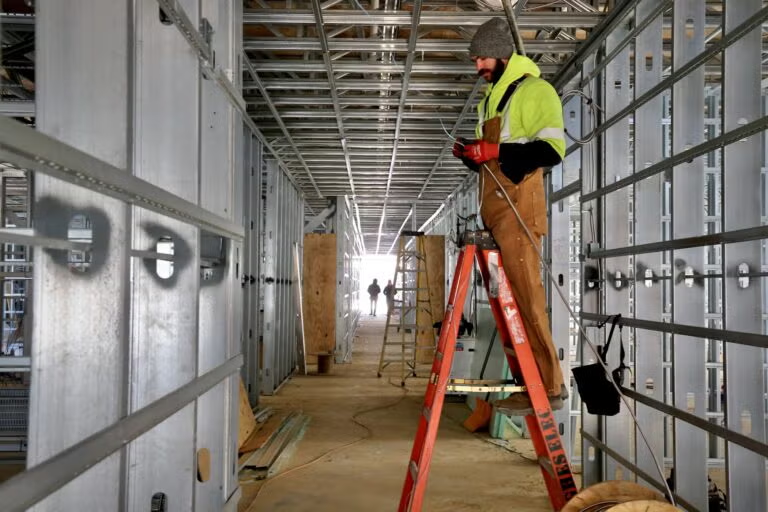
Labor Shortage Solutions: How Panelized CFS Reduces On-Site Framing Crews by 40%
Why Construction Labor Shortages Threaten Multifamily Project Schedules
Panelized cold-formed steel (CFS) framing reduces on-site labor requirements by 30-40% by shifting 80% of framing work from the jobsite to a controlled factory environment. According to BuildSteel.org case studies, prefabricating wall panels, trusses, and floor systems allows construction firms to complete multifamily framing faster with fewer workers, directly addressing the 500,000+ annual skilled worker shortage reported by the Associated Builders and Contractors (ABC).
Traditional stick framing depends on large teams of skilled carpenters working in sequence: layout crews first, then cutters, then framers, then sheathing installers. When any part of that chain runs short on workers, the entire project stalls. For multifamily developers, framing crew shortages cascade through the entire construction schedule.
- Schedule vulnerability: A framing delay pushes back every downstream trade, including MEP rough-in, insulation, drywall, and finishes, all waiting in sequence
- Cost escalation: Scarce labor drives wage premiums and overtime that erode pro forma margins
- Project feasibility risk: Unpredictable crew availability makes it difficult to commit to completion dates or secure construction financing
In Massachusetts and throughout New England, seasonal construction windows intensify labor shortage impacts. Projects that miss their framing window face months of weather delays under 780 CMR winter construction requirements.
Panelized CFS Reduces On-Site Framing Crews by 40 Percent
The labor reduction comes from a fundamental shift in construction methodology: approximately 80% of framing work moves from the jobsite to a factory. Instead of assembling walls stick-by-stick in the field, crews install prefabricated CFS panels that arrive ready for connection. BuildSteel.org documents carpentry man-hour reductions of 30-40% on panelized CFS projects compared to conventional stick framing. On a 7-story hotel project in Denver, only 6 crew members installed prefabricated CFS panels where traditional framing would have required 60-70 workers.
Crew Size Comparison: Stick Framing vs. Panelized CFS
| Framing Method | Typical Crew Size | Primary Tasks |
|---|---|---|
| Wood Stick Framing | 12-20 workers per floor | Layout, measuring, cutting, assembly, sheathing |
| Panelized CFS | 4-8 workers per floor | Panel setting, connection fastening, alignment verification |
The difference comes down to where the work happens. With stick framing, every stud gets measured, cut, and positioned on-site by skilled carpenters. With panelized CFS, all measuring, cutting, and assembly occurs in the factory using automated HOWICK roll-forming machinery. On-site crews connect pre-assembled components using screw fastening per AISI S240 connection requirements.
Labor Hours per Square Foot: 40-50% Reduction in Direct Framing Labor
SFIA market data indicates panelized CFS framing typically requires 0.15-0.20 labor hours per square foot, compared to 0.25-0.35 hours per square foot for conventional wood stick framing. That translates to a 40-50% reduction in direct framing labor hours. The savings compound on taller buildings: at 5+ stories, CFS construction per IBC Table 504.3 eliminates the Type IA concrete podium that wood-frame buildings require, removing an entire construction phase and its associated labor.
Framing Phase Duration with Factory-Built Panels
Panels arrive sequenced for installation order, eliminating the layout and cutting time that dominates stick framing schedules. A floor that takes two weeks to stick-frame can typically be completed with panelized CFS in three to four days. Faster framing means faster envelope closure; once the building is weathertight, interior trades can start regardless of exterior conditions.
How Factory Prefabrication Shifts Framing Labor Off-Site
The mechanism behind the 30-40% labor reduction is straightforward: work moves from unpredictable field conditions to a controlled manufacturing environment where productivity rates are higher and more consistent.
Controlled Manufacturing Environment vs. Field Conditions
Factory fabrication offers consistent conditions that jobsites cannot match: level floors, climate control, overhead cranes, and fixed workstations allow workers to maintain steady production rates throughout the day. On-site, crews contend with weather exposure, uneven surfaces, material scattered across multiple floors, and the constant coordination challenges of an active construction site. Even experienced crews see productivity drop 20-30% under adverse field conditions.
Automated Panel Fabrication with HOWICK Roll-Forming Equipment
Modern CFS fabrication uses automated roll-forming equipment that shapes flat steel coil into structural members with pre-punched holes for connections. HOWICK machinery and similar systems produce members cut to exact CAD specifications, eliminating manual measurement entirely. CFS fabrication achieves plus or minus 1/8" tolerances per AISI S240, compared to the plus or minus 1/4" to 3/8" field tolerances typical of dimensional lumber. Every member arrives exactly as designed.
Just-in-Time Delivery Reduces Site Staging and Material Handling
Panels ship in installation sequence, bundled and labeled for specific locations in the building. This just-in-time approach eliminates the material staging, sorting, and double-handling that consumes labor hours on conventional framing projects. Smaller crews work more efficiently when they are not searching for materials or reorganizing staging areas between phases.
Precision Fabrication Eliminates Rework and Field Adjustments
Field adjustments are a hidden labor sink on wood-framed projects. Dimensional lumber varies with moisture content, crowns and warps unpredictably, and rarely arrives at exactly the specified dimension. CFS precision fabrication eliminates this rework category, recovering labor hours that wood framing wastes on shimming, re-cutting, and member replacement.
CFS Tolerances vs. Dimensional Lumber Field Variability
CFS members maintain consistent dimensions because steel does not absorb moisture or change shape with humidity. A 3-5/8" stud measures 3-5/8" whether it is January or August, whether it is stored inside or delivered that morning.
- CFS precision: Factory-cut to CAD specifications with pre-punched connection holes that align consistently per AISI S240
- Wood variability: Moisture content changes dimensions; crowning requires field sorting; warping demands replacement or correction
- Connection alignment: Pre-punched CFS holes match design locations exactly; wood requires field drilling and frequent adjustment
Material Waste Reduction from Factory Optimization
Factory nesting algorithms optimize material use in ways that field cutting cannot match. BuildSteel.org data indicates CFS panel fabrication typically generates less than 2% material waste, compared to 10-15% waste rates common with dimensional lumber field cutting. Less waste means less material handling labor and lower material costs overall.
Weather Delay Elimination Through Indoor Fabrication
Factory fabrication proceeds regardless of weather conditions. Rain, snow, and extreme temperatures do not affect production schedules. On-site work is limited to panel installation, which is far less weather-sensitive than stick framing operations that require extended exterior exposure. For Massachusetts projects under 780 CMR, weather independence can mean the difference between a fall completion and a spring completion, saving months of construction loan carry.
Faster Building Envelope Closure Compresses Project Schedules
Rapid framing translates directly to faster envelope closure, and that is where schedule compression truly compounds. Once the building is weathertight, interior trades can work regardless of exterior conditions, enabling parallel work across multiple building systems.
Panel Erection Rates: 2x Stick Framing Productivity
Panelized CFS installation rates typically reach 800-1,200 square feet per crew per day, compared to 400-600 square feet for stick framing. Crane or forklift support allows small 4-8 person crews to set large panels quickly. A 5-story, 50,000 SF building that might require 10-12 weeks of stick framing can often complete structural framing in 4-5 weeks with panelized CFS, a 50-60% schedule reduction for the framing phase.
Trade Stacking and Parallel Work Enabled by Faster Framing
Trade stacking refers to multiple trades working simultaneously rather than sequentially on different floors. Faster framing completion enables earlier starts for electrical, plumbing, and HVAC rough-in, compressing overall project duration beyond just the framing phase savings. Each week of schedule compression reduces general conditions costs and construction loan interest.
Schedule Risk Reduction for Multifamily Developers
Predictable panel delivery and installation rates reduce the schedule uncertainty that plagues labor-constrained projects. For developers managing construction loan interest, delayed rent-up timelines, and seasonal completion targets, schedule predictability has real financial value that factors directly into project feasibility and investor returns.
Cost Analysis: Panelized CFS Labor Savings per Square Foot
Labor reductions translate to measurable cost savings across both direct framing costs and indirect project costs. The full picture includes savings that extend well beyond the framing trade line item.
Direct Labor Cost Comparison: RSMeans 2024 Data
RSMeans 2024 data for the Boston market indicates framing labor costs of $8.50-$12.00 per square foot for conventional wood stick framing, compared to $5.50-$8.00 per square foot for panelized CFS installation. The 30-40% labor hour reduction drives proportional cost savings on the framing scope. Material costs differ between systems, so total installed cost comparisons require project-specific analysis.
Indirect Savings from Reduced General Conditions Duration
Faster framing reduces overall project duration, which lowers general conditions costs: site supervision, temporary facilities, equipment rental, builder's risk insurance, and construction loan interest. On a 12-month project, compressing the schedule by 6-8 weeks can save 2-3% of total project cost in general conditions alone. Indirect savings often exceed direct labor savings on larger multifamily projects.
Break-Even Height: CFS vs. Wood Frame Construction
SFIA market data indicates cost parity between CFS and wood framing typically occurs at 5 stories. Below that threshold, wood's lower material cost often outweighs CFS labor savings. Above 5 stories, FRT lumber requirements per IBC Table 504.3 and podium construction costs shift economics decisively toward CFS. At 6 stories, CFS saves approximately $13.42/SF compared to wood-over-podium construction. At 7 stories, savings reach $21.11/SF per SFIA 2023 data.
Crew Training Requirements for CFS Panel Installation
Transitioning crews from wood framing to CFS panel installation requires training, though the learning curve is manageable for experienced construction workers. Most crews achieve installation proficiency within 1-2 weeks of supervised practice.
Skill Transition from Wood Framing to Steel Assembly
The fundamental construction skills transfer directly: reading plans, maintaining plumb and level, sequencing work efficiently. The differences are primarily in tools and connection methods. CFS installation uses screw fastening rather than nailing, panel alignment rather than stick layout, and panel maps rather than traditional framing plans. SFIA member companies and equipment manufacturers like HOWICK offer structured training programs to accelerate the transition.
Tool Requirements for CFS Screw Fastening
- Screw guns: Self-drilling screw installation per AISI S240 connection requirements
- Metal cutting: Aviation snips and abrasive cut-off tools for field modifications
- Alignment tools: Laser levels and plumb equipment for panel positioning
- Lifting equipment: Crane or forklift support for panel setting on multi-story structures
Quality Control and Inspection per IBC Section 1705.11
CFS framing requires special inspection per IBC Section 1705.11 as adopted by Massachusetts 780 CMR. Inspectors verify connection fastener spacing, member orientation, and load path continuity at designated checkpoints throughout construction. These inspections ensure assemblies match UL-listed designs and AISI design standards (S100, S240, S400), maintaining the structural and fire performance ratings the building requires.
Frequently Asked Questions About Panelized CFS and Labor Reduction
How does panelized cold-formed steel installation work with union labor agreements in Massachusetts?
Panelized CFS installation typically falls under ironworker or carpenter jurisdiction depending on local agreements. Project teams should verify scope classification with applicable unions before bidding to avoid jurisdictional disputes that could affect project scheduling and labor costs.
What training duration do wood framing crews need to transition to CFS panel installation?
Most experienced framing crews achieve installation proficiency within 1-2 weeks of supervised practice. SFIA member companies and equipment manufacturers like HOWICK offer structured training programs that cover screw fastening per AISI S240, panel alignment procedures, and quality control checkpoints per IBC Section 1705.11.
Can panelized CFS be used for mid-rise buildings above six stories in Massachusetts?
CFS framing is code-compliant for mid-rise construction up to allowable heights per IBC Tables 504.3 and 504.4 as adopted by Massachusetts 780 CMR. Type IIA and Type IIB construction types enable buildings that exceed traditional wood-frame height limits without podium construction, reaching 5 stories and 75 feet with NFPA 13 sprinkler systems under IBC Section 504.2.
Ready to reduce on-site labor requirements by 30-40% on your next multifamily project? AAC Steel Engineering provides panelized CFS feasibility analysis, labor hour estimates, schedule projections, and cost comparisons for Massachusetts multifamily developments. Contact AAC Steel Engineering for project-specific analysis.