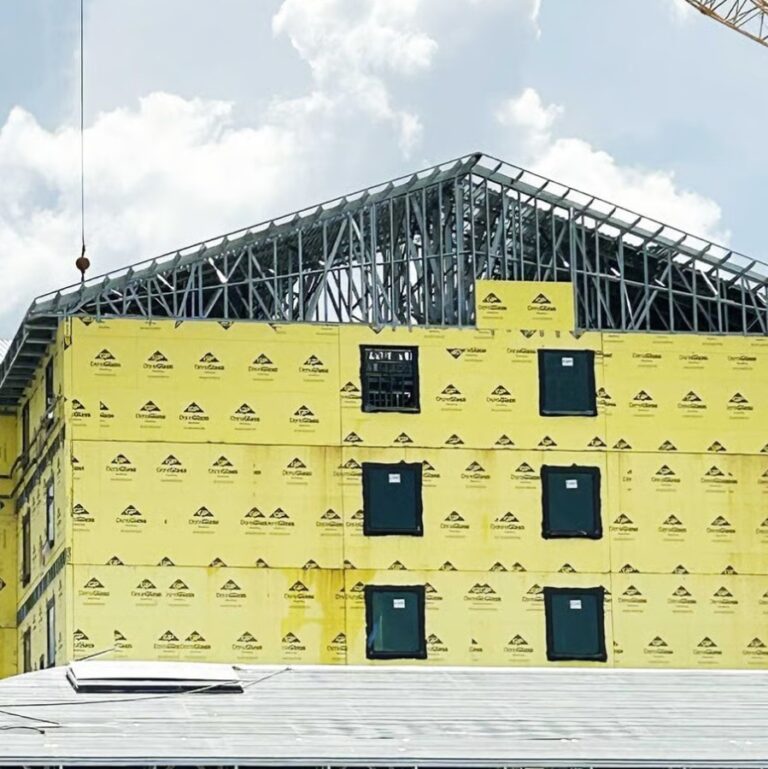
Massachusetts 780 CMR Building Code Guide for Cold-Formed Steel Construction
Massachusetts 780 CMR Code Structure for Cold-Formed Steel Buildings
The Massachusetts 10th Edition Building Code (780 CMR), based on the 2021 International Building Code (IBC), regulates cold-formed steel (CFS) construction through several interconnected chapters. CFS qualifies as non-combustible per ASTM E136, which opens the door to Type I and Type II construction — allowing buildings to reach heights that combustible wood framing cannot achieve under the same code provisions.
Massachusetts developers planning 5+ story multifamily buildings face a critical decision: use expensive Type IA concrete podiums under wood framing, or leverage CFS non-combustible classification to build taller without the podium cost. The difference can exceed $730,000 and 51 weeks of construction time per floor. This guide covers the 780 CMR code structure, construction type selection, fire-rated assembly requirements, and permit review process for CFS projects in Massachusetts.
780 CMR provisions for CFS appear across multiple chapters. Chapter 22 covers steel design requirements and references AISI standards. Chapter 56 addresses wall construction. Chapter 35 lists all referenced standards that become legally enforceable once adopted into Massachusetts law.
- Chapter 22: Governs engineered CFS structural design and references AISI S100, S240, and S400 standards
- Chapter 35: Incorporates AISI standards by reference, making them legally enforceable in Massachusetts
- Section 5603: Provides prescriptive wall framing tables for limited applications
- Section 51.00: Establishes wind load requirements following ASCE 7
The code limits CFS-framed shear walls to specific sheathing materials: steel sheets, wood structural panels, gypsum board, or fiberboard. Buildings using CFS shear walls are limited to 35 feet in height under prescriptive provisions, though engineered design per AISI S240 removes this restriction entirely.
Construction Type Classification for CFS Under 780 CMR Tables 504.3 and 504.4
Construction type determines allowable building height and area under 780 CMR. Tables 504.3 and 504.4 define base height and area allowances for each construction type, and CFS qualifies for types that wood construction cannot reach because of its non-combustible classification per ASTM E136.
Type IIB Non-Combustible CFS Enabling Multi-Story Buildings
Type IIB is where most mid-rise CFS projects land. Per IBC Table 601, no hourly fire-resistance rating is required on the primary structural frame in Type IIB construction. Because CFS is non-combustible, it qualifies for significantly greater height and area than Type IIIA or Type VA wood construction under the same tables.
Type IIB CFS eliminates the expensive concrete podium that wood-framed buildings typically require for taller structures. Instead of building a Type IA concrete base and stacking wood on top, a developer can go full CFS from foundation to roof — saving $12–15/SF per RSMeans 2024 on the podium alone.
Type IIIA Protected CFS with Fire-Rated Assemblies
Type IIIA requires fire-rated interior elements but allows either combustible or non-combustible exterior walls. Some architects select Type IIIA for specific height and area trade-offs, though Type IIB typically offers better economics for CFS projects because it avoids the cost of fire-rating the structural frame per IBC Table 601.
Height and Area Allowances by Construction Type
The difference between construction types is dramatic for R-2 multifamily occupancies. Base allowances can be increased further with automatic sprinkler systems and frontage bonuses per IBC Section 506.
| Construction Type | Non-Combustible Classification | Typical CFS Application |
|---|---|---|
| Type IIB | Yes (per ASTM E136) | Mid-rise multifamily, 5–6+ stories |
| Type IIIA | Varies | Protected construction with UL-rated assemblies |
| Type VA | No | Limited height; loses CFS non-combustible advantage |
780 CMR Chapter 22 Steel Provisions for CFS Structural Framing
Chapter 22 covers both hot-rolled structural steel and cold-formed steel, with Section 2211 specifically addressing CFS framing systems. The distinction between Chapter 22 and Section 5603 matters: Chapter 22 governs engineered design using AISI S100 and AISI S240, while Section 5603 provides prescriptive tables for simpler, smaller buildings.
Most multifamily projects in Massachusetts require engineered design because they exceed prescriptive limits on height, wind speed, or seismic conditions. This is actually an advantage rather than a limitation, since engineered design per AISI S240 unlocks the full height and area potential of CFS construction under Tables 504.3 and 504.4.
780 CMR Section 5603 Wall Framing Applicability Limits
Section 5603 offers a prescriptive path for CFS wall framing that does not require project-specific engineering. However, the limitations are tight, and understanding them helps determine immediately whether a project qualifies or requires full engineered design.
Building Height Limits Under Section 5603.1.1
The prescriptive code limits buildings to 35 feet measured from mean grade plane to mean roof plane. Any building taller than 35 feet requires engineered design per AISI S240 and Chapter 22, which then allows CFS construction to the full height limits of the selected construction type.
Wind Speed and Exposure Category Restrictions
Prescriptive tables in Section 5603 are limited to specific ultimate design wind speeds and exposure categories. Massachusetts coastal areas often exceed prescriptive wind speed limits, which automatically triggers engineered design requirements regardless of building height.
Steel Member Properties Per Section 5603.2
When prescriptive design does apply, Section 5603.2 specifies minimum steel thickness, yield strength per ASTM A1003, and galvanized coating requirements per ASTM A653. The prescriptive tables provide stud sizes and spacing for various wall heights and load conditions.
CFS Metal Stud Specifications Meeting 780 CMR Requirements
In CFS terminology, a "2x4 metal" stud carries a designation like 362S162 following SSMA (Steel Stud Manufacturers Association) nomenclature. The numbers indicate a 3.625-inch web depth and 1.625-inch flange width. These specifications tie directly to ASTM material standards referenced in 780 CMR Chapter 35.
ASTM A1003 SS Grade 33 and Grade 50 Steel
The structural steel (SS) designation distinguishes load-bearing members from non-structural (NS) steel. Grade 33 indicates 33 ksi yield strength and is suitable for non-load-bearing partitions. Grade 50 indicates 50 ksi yield strength and is the standard for load-bearing applications in multifamily construction. NS steel is not permitted for structural framing under 780 CMR.
Minimum Base Metal Thickness by Stud Designation
The mil thickness system directly relates to structural capacity. Thicker steel carries more load and spans greater wall heights.
- 33 mil (20 gauge): Non-load-bearing interior partitions only
- 54 mil (16 gauge): Standard load-bearing walls in typical multifamily applications
- 68 mil (14 gauge): Heavy load-bearing walls or tall wall conditions
- 97 mil (12 gauge): Maximum load applications and long spans
Galvanized Coating Requirements Per ASTM A653
G60 and G90 designations indicate the weight of zinc coating applied to the steel for corrosion protection. G60 provides adequate protection for interior applications, while exterior and high-humidity applications typically require G90 minimum coating to meet 780 CMR durability expectations.
AISI Standards Referenced in 780 CMR Chapter 35
Chapter 35 incorporates AISI standards by reference, making them legally enforceable in Massachusetts. The adopted editions may lag behind current AISI publications, so verifying which edition applies at permit time is essential for code compliance.
- AISI S100: The primary design standard for CFS structural members, providing the Effective Width Method and Direct Strength Method for calculating member capacities
- AISI S240: The standard for CFS structural framing systems, covering floor, wall, and roof framing design requirements for buildings
- AISI S400: The seismic design standard for CFS lateral force-resisting systems including shear walls and strap bracing per ASCE 7 seismic provisions
Fire Resistance Assemblies for CFS Under 780 CMR Table 601
IBC Table 601 (adopted by 780 CMR) specifies required fire-resistance ratings by construction type. While CFS framing is non-combustible per ASTM E136, achieving hourly fire ratings requires tested assemblies with specific gypsum board configurations, screw patterns, and installation details listed in the UL Fire Resistance Directory.
UL Design H514 Bearing Wall Assemblies
UL Design H514 achieves 1-hour or 2-hour fire-resistance ratings for load-bearing CFS walls when tested per ASTM E119. Critical parameters include two layers of 5/8" Type X gypsum board on each side, #6 Type S screws at 12" o.c. in the field and 8" o.c. at the perimeter, and specific stud spacing requirements detailed in the UL listing.
UL Design G602 Floor-Ceiling Assemblies
UL Design G602 provides horizontal fire separation between floors in CFS construction. The assembly typically includes a structural deck on top, a gypsum board ceiling below, and resilient channels at 16" o.c. for both fire and acoustic performance. Specific layer counts and fastener patterns are detailed in the UL listing.
Firestop Systems Per ASTM E814 and UL 1479
Every penetration through a fire-rated assembly requires a tested firestop system per ASTM E814. Firestop systems are assembly-specific and penetrant-specific, meaning the correct system depends on both the rated assembly being penetrated and the type of pipe, conduit, or cable passing through. Generic fire caulk does not qualify as a listed firestop system under 780 CMR.
Wind Load Requirements for CFS Per 780 CMR Section 51.00
Section 51.00 adopts ASCE 7 for determining wind loads in Massachusetts. Coastal areas see significantly higher design wind speeds than inland locations. CFS wall framing handles both in-plane loads as part of the lateral system (per AISI S400) and out-of-plane loads from wind pressure causing stud bending (per AISI S100).
Projects exceeding prescriptive wind speed limits require engineered design, which provides greater design flexibility rather than limiting options. The engineer can optimize member sizes and connections for the specific wind conditions at the project site.
Massachusetts Stretch Energy Code Compliance for CFS Thermal Envelope
Many Massachusetts municipalities have adopted the Stretch Energy Code, which imposes stricter energy performance requirements than base 780 CMR. CFS thermal design centers on addressing thermal bridging through steel framing, since steel conducts heat approximately 400 times more readily than wood.
Continuous Insulation R-Value Requirements
Continuous insulation (ci) installed on the exterior side of CFS framing is the primary solution for thermal bridging. Common products include rigid polyisocyanurate boards and mineral wool boards, with required R-values determined by Massachusetts climate zone. The ci layer wraps the entire building envelope without interruption at steel framing members.
Modified Zone Method Thermal Calculations
The Modified Zone Method per ASHRAE 90.1 Appendix A accurately accounts for steel thermal bridging in U-factor calculations. Simpler parallel-path calculations underestimate heat loss through CFS assemblies because they do not properly account for the thermal bridging effect of steel studs. Using the Modified Zone Method is essential for accurate energy code compliance documentation.
Special Inspection Requirements Per 780 CMR Section 1705.11
Section 1705.11 requires special inspection for CFS structural framing. Special inspection means inspection by a qualified individual hired by the owner, performed in addition to standard municipal building department inspections. This requirement applies to welded connections per AWS D1.3, mechanical fastener verification, and hold-down and anchor bolt installation.
Massachusetts Building Department CFS Permit Review Process
Familiarity with CFS construction varies among local building departments across Massachusetts. Pre-application meetings help streamline the review process, particularly for departments with less experience reviewing CFS projects.
Typical submittal requirements include:
- Signed and sealed structural drawings by a Massachusetts-licensed Professional Engineer
- Fire-rated assembly documentation with specific UL design numbers (H514, G602, L541)
- Energy code compliance documentation with thermal calculations per the Modified Zone Method
- Special inspection program per Section 1705.11 outlining inspection requirements and responsible parties
Common plan review comments on CFS projects include requests for missing fire-rated assembly designations, incomplete connection details, unclear delegated design scope for components like trusses, and insufficient energy code documentation for thermal bridging.
FAQs About Massachusetts 780 CMR and Cold-Formed Steel Construction
Does Massachusetts 780 CMR require a licensed PE for cold-formed steel structural design?
Yes. Structural design of CFS framing systems in Massachusetts requires a Professional Engineer licensed in the state, with drawings signed and sealed per Board of Registration requirements. This applies to both the engineer of record and any delegated design engineers responsible for CFS framing components.
Can cold-formed steel buildings exceed the prescriptive height limits in 780 CMR Section 5603?
Yes. Buildings exceeding the 35-foot limit in Section 5603.1.1 require engineered design per AISI S240 and Chapter 22, which then allows CFS construction to the full height and area limits of the selected construction type per Tables 504.3 and 504.4. Most mid-rise multifamily projects use this engineered design path.
What is the difference between 780 CMR 9th Edition and 10th Edition for cold-formed steel construction?
The 9th Edition is based on IBC 2015, while the 10th Edition updates to IBC 2021 with revised AISI standard references and updated seismic and wind provisions per ASCE 7. Verifying which edition applies at the time of permit application is essential since the transition period may affect which requirements govern a specific project.
Are ICC-ES Evaluation Service Reports accepted by Massachusetts building officials for CFS products?
ICC-ES reports are generally accepted as evidence of code compliance under 780 CMR Section 104.11 covering alternative materials and methods. However, building officials have discretion to require additional documentation depending on the specific product and application.
Planning a CFS project under Massachusetts 780 CMR? AAC Steel Engineering provides complete design-assist services including 780 CMR compliance review, AISI-based structural engineering, UL-listed fire-rated assembly selection, and prefabricated panel fabrication using HOWICK machinery. Contact AAC Steel Engineering for project-specific feasibility analysis.