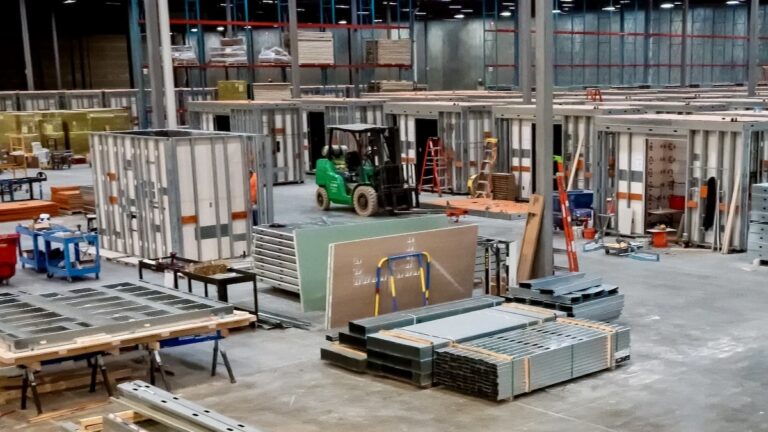
Modular Steel Frames for Faster Multi-Family Construction
Why Multi-Family Construction Schedules Fail in Northeast Markets
Modular cold-formed steel (CFS) frame construction accelerates multi-family projects by 30–50% compared to conventional wood framing. CFS panels are fabricated off-site in factory-controlled conditions while site work proceeds simultaneously. Once panels arrive, smaller crews install them using bolted and screwed connections rather than building walls stud-by-stud on site.
This parallel-path approach eliminates the sequential delays that compound on stick-built projects. Weather interruptions, material shortages, and field fabrication errors do not just add days—they compound into months of schedule overrun and six-figure carrying-cost increases.
Weather Delays and New England Climate Impact
New England's freeze-thaw cycles, rain, and humidity create unpredictable windows for on-site wood framing. Stick-built framing halts during active weather events, and moisture exposure during construction can compromise fire-retardant treated (FRT) lumber performance before the building is enclosed.
CFS panel fabrication happens indoors regardless of exterior conditions. Only final installation requires favorable weather—and even then, steel tolerates brief moisture exposure without the warping, swelling, or treatment degradation that affects wood.
Skilled Framing Labor Shortages
Experienced wood framers are increasingly difficult to find in the Northeast. Wage escalation and crew availability constraints mean that even well-planned projects face delays when framing crews are booked months out or unavailable.
Panelized CFS installation requires smaller crews with different skill sets. Panels arrive pre-assembled per AISI S240 specifications and ready to connect, simplifying the installation process once crews are trained on screw-gun assembly methods.
Fire-Retardant Treated Lumber Lead Times
FRT lumber is required for Type III construction above certain heights per IBC Table 601. Extended procurement lead times—often 6–12 weeks—and unpredictable supply chains create scheduling uncertainty before framing even begins.
CFS eliminates this constraint entirely. Steel qualifies as non-combustible per ASTM E136, enabling projects to pursue Type IIA or IIB construction without waiting on FRT lumber deliveries.
On-Site Fabrication Errors and Rework
Field-cut framing introduces dimensional variability that causes cascading problems. Wood framing typically achieves ±1/4" to ±3/8" field tolerance, while factory-fabricated CFS panels maintain ±1/8" precision through CAD-controlled roll-forming per AISI S240 tolerance standards.
This precision difference compounds across a building. Tighter tolerances reduce drywall cracking, door and window fitting issues, and callback rates—all of which affect both schedule and cost.
How Prefabricated Cold-Formed Steel Panels Compress Timelines
Prefabricated CFS panels reduce framing phase duration by 50–60% compared to stick-built approaches, according to SFIA industry data. Three mechanisms work together to create this schedule compression.
Parallel Path Construction with Factory Fabrication
Panel fabrication occurs simultaneously with site work, foundation, and permitting. Conventional wood framing cannot begin until prior phases complete. CFS fabrication proceeds in parallel—often starting during design development.
This parallel path represents the single largest schedule advantage. A project that would otherwise wait weeks for framing to begin can have panels ready for installation the day the foundation is complete.
Panel Sequencing and Just-in-Time Delivery
Panels arrive in installation order, eliminating material sorting and staging. Coordinated delivery schedules match daily installation capacity, so crews are not waiting for materials or searching through stacked lumber.
For constrained urban sites common in Massachusetts infill development, this approach also reduces laydown area requirements. Panels are installed shortly after delivery rather than stored on-site for extended periods.
Reduced Field Framing Duration
Pre-assembled panels bolt together rather than requiring individual stud-by-stud field framing. The reduced connection count and simplified assembly sequence translate directly to fewer labor hours on site.
| Factor | Stick-Built Wood Framing | Panelized Cold-Formed Steel |
|---|---|---|
| Fabrication Location | On-site | Factory-controlled |
| Weather Dependency | High | Minimal (installation only) |
| Dimensional Tolerance | ±1/4" to ±3/8" | ±1/8" per AISI S240 |
| Installation Sequence | Individual components | Pre-assembled panels |
IBC Construction Types That Enable Faster Multi-Family Completion
The schedule advantages of CFS become most significant at five stories and above. At this height threshold, IBC construction type classification determines whether a concrete podium is required—and that single factor can add 8–12 weeks to a project.
Type IIA and IIB Non-Combustible Classifications per IBC Table 601
Type IIA construction requires 1-hour fire resistance ratings for structural elements. Type IIB requires no fire resistance rating for the structure itself. CFS qualifies as non-combustible per ASTM E136, enabling either classification without the material limitations of wood framing.
Per IBC Tables 504.3 and 504.4, non-combustible construction types permit greater building heights and areas for R-2 occupancy (multi-family residential) than combustible alternatives—opening design possibilities unavailable with wood.
Eliminating Type IIIB Podium Construction for Five-Plus Story Buildings
Podium construction—a concrete-and-steel base supporting wood-framed floors above per IBC Section 510.2—adds 8–12 weeks to project schedules and $12–15/SF in construction cost, per RSMeans 2024 Boston market data.
Full CFS construction eliminates the podium phase entirely. A five-story building proceeds with consistent framing from foundation to roof, removing the transition between structural systems that creates schedule complexity and coordination challenges.
- No podium required: Full CFS construction eliminates 8–12 weeks of concrete work
- Consistent framing system: One structural approach from foundation to roof per AISI S100/S240
- Greater height allowances: Non-combustible classification per IBC Table 504.3
- Simplified coordination: No transition between concrete podium and wood framing
Note: For projects in Massachusetts, verify construction type allowances against 780 CMR amendments, which may differ from base IBC provisions.
How Faster Schedules Reduce Total Multi-Family Project Costs
Schedule compression translates directly to financial outcomes. Each month of construction duration represents carrying costs that disappear when the timeline shortens.
Carrying Cost Savings per Month of Schedule Compression
Construction loan interest, property taxes during construction, and insurance premiums all accrue monthly. For a typical multi-family project, carrying costs range from $50,000–$100,000 per month depending on project size and financing terms.
A 20% schedule reduction on a 12-month project eliminates roughly 2.4 months of carrying costs—potentially $120,000–$240,000 in soft cost savings alone. This money never appears in a line-item construction budget but absolutely affects project returns.
Earlier Tenant Occupancy and Revenue Capture
Faster completion enables earlier lease-up and rental income. The compounding effect of earlier revenue streams on project returns often exceeds the direct cost savings from schedule compression. For build-to-rent developments, this timing advantage can significantly improve project IRR even when construction costs are comparable between framing systems.
Insurance Premium Advantages from Non-Combustible Construction
Non-combustible CFS construction qualifies for lower builder's risk premiums during construction. Long-term property insurance advantages from Class A fire-rated assemblies per ASTM E84 deliver up to 38.2% savings over a 30-year lifecycle, per SFIA market data—potentially exceeding $1 million in cumulative savings for larger projects.
- Reduced carrying costs: Shorter schedules mean fewer months of construction loan interest
- Earlier revenue: Faster occupancy enables quicker rent collection
- Lower insurance: Non-combustible classification reduces both construction and operational premiums
- Simplified process: Eliminating podium construction removes schedule complexity
Fire-Rated Assembly Options for Multi-Family Steel Construction
CFS assemblies achieve required fire ratings through tested UL designs that specify exact construction parameters. Following the specifications precisely is what makes the rating valid.
UL Design Designations for CFS Wall and Floor Assemblies
UL Design U425 provides 1–2 hour fire ratings for load-bearing CFS wall assemblies using specified gypsum board layers, screw spacing, and insulation. UL Design L541 achieves similar ratings for floor-ceiling assemblies with CFS joists, structural deck, resilient channels at 16" o.c., and Type X gypsum board.
All assemblies are tested per ASTM E119 and listed in the UL Fire Resistance Directory. Compliance requires following exact specifications—layer count, screw size and spacing, and component manufacturers all matter.
Achieving Class A Fire Ratings per ASTM E84
Class A fire rating requires a flame spread index of 0–25 and smoke development index of 0–450 per ASTM E84. CFS framing with proper gypsum finishing achieves Class A ratings, providing the fire performance that supports lower insurance premiums over the building's lifetime.
| Assembly Type | UL Design Example | Fire Rating | Key Components |
|---|---|---|---|
| Load-bearing wall | UL U425 | 1–2 hour | CFS studs, Type X gypsum, insulation |
| Floor-ceiling | UL L541 | 1–2 hour | CFS joists, structural deck, resilient channel, Type X gypsum |
Schedule Advantages of Cold-Formed Steel for Five-Plus Story Buildings
The cumulative schedule and cost advantages of CFS increase with building height. At five stories and above, podium elimination per IBC Section 510.2 provides the largest single benefit—but the advantages stack: 50–60% shorter framing phase duration per BuildSteel.org case studies, parallel fabrication, and simplified trade coordination.
Project-specific analysis is essential. Building configuration, site constraints, and local code requirements—including 780 CMR amendments in Massachusetts—all affect the actual schedule advantage for any given project.
Frequently Asked Questions About Modular Steel Frame Construction Speed
How long does it take to erect prefabricated cold-formed steel wall panels on a multi-family project?
Prefabricated CFS panels typically install 50–60% faster than stick-built framing per SFIA data. Panels arrive pre-assembled and require only bolted or screwed connections at the job site. Erection speed depends on building configuration, crew experience, and panel complexity.
What is the typical lead time for ordering prefabricated cold-formed steel panels?
Engineering, fabrication, and delivery typically require several weeks of advance coordination—often shorter than FRT lumber procurement in constrained supply conditions, which can extend to 6–12 weeks. Lead times vary based on project complexity and fabricator capacity.
How do building code inspections work with prefabricated cold-formed steel assemblies?
Prefabricated CFS assemblies require special inspection per IBC Section 1705.11. Inspection typically occurs both at the fabrication facility and during field installation to verify compliance with approved shop drawings, AISI S240 specifications, and UL-listed assembly requirements.
Accelerate Your Next Multi-Family Project. AAC Steel's precision-engineered CFS panels compress construction timelines by 30–50% while eliminating podium construction for five-plus story buildings. Contact AAC Steel's Engineering Team for a project-specific feasibility analysis including construction type evaluation, schedule modeling, and cost comparison for Massachusetts and New England multi-family projects.