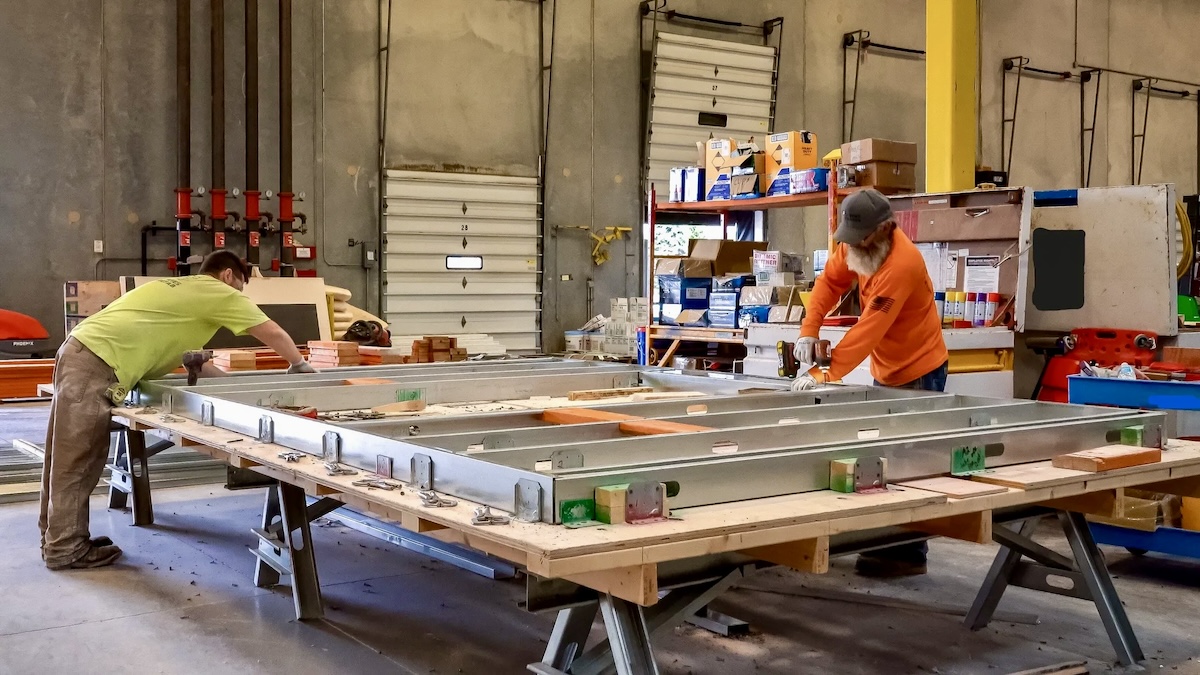
Precision Manufacturing for Cold-Formed Steel Framing
What Is Precision Manufacturing in Cold-Formed Steel Framing?
Precision manufacturing for cold-formed steel (CFS) framing uses automated, CAD-driven roll-forming machines to produce structural components with tolerances within ±1/8". This off-site fabrication process creates customized studs, joists, and panels under factory-controlled conditions—delivering consistent quality, 50–60% faster framing speeds, and fewer on-site errors compared to field-cut lumber.
The term "cold-formed" describes shaping steel at room temperature rather than using heat. Flat steel coils pass through sequential roller dies that gradually bend the material into C-shapes, tracks, and structural members per AISI S240 standards—all without compromising the steel's inherent strength.
The Cold Forming Process and Material Properties
During roll forming, mechanical cold working increases the steel's yield strength compared to the base material. This effect allows thinner sections to carry substantial loads while remaining lightweight enough for efficient handling on site.
Steel grades follow ASTM A1003 specifications:
- SS Grade 33 (33 ksi minimum yield): Typically used for non-structural applications like interior partitions
- SS Grade 50 (50 ksi minimum yield): Used for load-bearing members requiring higher strength
- Galvanized coatings (G60 or G90): Provide corrosion protection appropriate for the building's exposure conditions
Cold-Formed Steel vs. Hot-Rolled Steel Manufacturing
Hot-rolled steel uses temperatures above the recrystallization point to form thick structural shapes like W-beams and hollow structural sections (HSS), designed per AISC 360. Cold-formed steel works at ambient temperature to produce thinner-gauge framing members designed per AISI S100. Each serves different structural applications in construction.
| Feature | Cold-Formed Steel | Hot-Rolled Steel |
|---|---|---|
| Forming Temperature | Ambient/room temperature | Above recrystallization point |
| Typical Thickness | 33 mil to 97 mil (18–12 gauge) | 1/4" and thicker |
| Primary Applications | Wall studs, joists, trusses | Columns, beams, heavy structural |
| Design Standard | AISI S100 / S240 | AISC 360 |
| Dimensional Precision | ±1/8" typical | Wider tolerances |
Manufacturing Tolerances and Dimensional Accuracy in CFS Fabrication
Tight tolerances matter enormously for multi-story construction. When panels stack across five or six floors, even small dimensional errors compound—a 1/4" variance per floor becomes 1.5" of misalignment by the sixth story, creating costly field corrections and trade coordination failures.
AISI S240 Tolerance Standards for CFS Members
AISI S240 (North American Standard for Cold-Formed Steel Structural Framing) establishes tolerance requirements for member depth, flange width, and web flatness. The standard ensures components from different production runs fit together predictably—critical when thousands of members come together on a single project.
How CFS Fabrication Precision Compares to Wood Framing
Factory-controlled CFS fabrication achieves ±1/8" tolerance, while dimensional lumber cut in the field varies by ±1/4" to ±3/8". That 2–3x precision improvement translates directly to installation efficiency and fewer callbacks.
- Pre-punched connections: Eliminate field drilling and layout time entirely
- Pre-cut members: Arrive at exact length with no field cutting required
- Cumulative alignment: Tighter tolerances mean fewer shims and faster panel connections across multiple stories
- Floor-to-floor consistency: Predictable dimensions reduce coordination issues with MEP and finish trades
ASTM A1003 Material Specifications and Steel Grades
ASTM A1003 governs the steel itself—chemical composition, mechanical properties, and coating requirements. The specification defines structural steel (SS) and structural high-strength low-alloy steel (HSLAS) grades, with minimum yield strengths ranging from 33 ksi to 50 ksi depending on application requirements.
How Roll Forming Technology Achieves Profile Consistency
The machinery behind precision manufacturing determines output quality. Roll forming equipment represents a significant capital investment that enables production consistency field fabrication cannot match.
Roll Form Tooling Design and Die Engineering
Progressive dies gradually shape flat coil into the final profile through a series of forming stations. Tooling design accounts for springback—the steel's tendency to partially return to its original shape—ensuring the finished member meets dimensional targets per AISI S240. HOWICK roll forming equipment represents industry-standard machinery for CFS framing production.
Servo-Driven Punching and Hole Placement Systems
Automated punching systems create web holes, service knockouts, and connection points at programmed locations. Servo control enables positioning accuracy measured in fractions of an inch, eliminating the need for field drilling and manual layout. Every hole lands exactly where the structural engineer specified per AISI S100 calculations.
How CAD and BIM Integration Enables Fabrication Precision
Precision starts in design, not on the production floor. When structural models export directly to fabrication equipment, the digital design becomes the physical product without manual interpretation errors.
BIM-to-Fabrication Data Transfer Workflows
Building Information Modeling (BIM) software generates fabrication data that drives roll forming and punching equipment directly. This digital thread catches coordination issues—ductwork conflicts, electrical penetrations, plumbing chases—before manufacturing begins rather than during installation when changes cost 5–10x more to resolve.
Load-Bearing Calculations on Digital Models
Structural analysis runs on the same model used for fabrication, ensuring designed members match produced members exactly. Engineers apply AISI S100 (North American Specification for the Design of Cold-Formed Steel Structural Members) calculation methods and ASCE 7-22 load requirements to verify capacity before any steel is cut.
Cost Advantages of Precision CFS Manufacturing
Upfront precision reduces total project cost through downstream efficiencies. The investment in accurate fabrication pays dividends throughout construction and across the building's 30-year lifecycle.
Elimination of Type IA Podium Construction per IBC
For buildings above four stories, CFS construction types (Type IIA, Type IIB per IBC Table 601) eliminate concrete podium requirements per IBC Section 510.2. Per IBC Tables 504.3 and 504.4, non-combustible construction allows greater height and area than wood-framed alternatives.
According to BuildSteel.org case studies, podium elimination removes 8–12 weeks of schedule and $12–15/SF in construction cost. At six stories, CFS saves approximately $13.42/SF compared to FRT lumber plus podium construction (RSMeans 2024, Boston market).
Reduced Field Rework and Material Waste
Pre-punched, pre-cut panels arrive ready for assembly. CFS panel waste typically runs below 2%, compared to 10–15% for dimensional lumber. Steel scrap retains commodity value for recycling, while wood waste becomes a disposal cost.
Insurance Premium Reductions from Non-Combustible Classification
Non-combustible construction classification per ASTM E136 testing affects property insurance underwriting favorably. SFIA industry reports document up to 38.2% premium savings over a 30-year lifecycle—potentially exceeding $1 million on larger multi-family projects.
Total Cost Comparison Tip: When comparing CFS to wood framing costs, include lifecycle factors: insurance premiums, maintenance requirements, and capacity reductions from FRT lumber treatments. First-cost comparisons alone miss the full economic picture.
How Prefabricated CFS Panels Compress Construction Schedules
Factory production continues regardless of weather conditions. While site work proceeds, panels fabricate in parallel—then arrive sequenced for immediate installation, reducing on-site construction time by 20% or more compared to stick framing.
Factory-Controlled Manufacturing vs. Field Fabrication
Climate-controlled factory conditions, specialized HOWICK equipment, and trained crews produce consistent output independent of weather. Field fabrication faces weather exposure, labor availability challenges, and portable tool limitations. The difference shows in both quality and speed.
Just-in-Time Delivery and Installation Sequencing
Coordinated delivery schedules match installation pace, reducing site storage requirements and double-handling. Panels arrive labeled by building location in installation order, enabling crews to move directly from truck to erected position without sorting through material stacks.
Fire Rating and Code Compliance Through CFS Precision Engineering
Fire ratings depend on exact assembly construction—correct layer counts, screw spacing, and component positioning per UL-listed designs. Precision manufacturing ensures components comply with tested configurations down to the last fastener.
IBC Construction Type Classifications for CFS Buildings
IBC Table 601 establishes fire-resistance requirements by construction type, while Table 602 addresses exterior wall requirements. Type IIA and IIB construction using CFS framing allows significant height and area per Tables 504.3 and 504.4, often exceeding wood-framed alternatives for R-2 multi-family occupancy.
UL Fire-Rated Assembly Designations for CFS Systems
Common UL designs for CFS assemblies include H505, H514, L541, M527, N501, D902, D925, and G602. Each designation specifies exact construction requirements tested per ASTM E119.
For example, UL Design H514 achieves a 1-hour fire rating with specific 5/8" Type X gypsum board layers, #6 Type S screws at defined spacing, and 25-gauge resilient channels at 16" on center. Assemblies constructed to the tested specifications perform as rated; deviations void the rating entirely.
AISI S100, S240, and S400 Design Standards Compliance
AISI S100 governs structural design using the effective width method for member capacity calculations. AISI S240 covers framing applications including tolerances and installation requirements. AISI S400 addresses lateral system design for seismic and wind resistance, and ASCE 7-22 determines load requirements.
Quality Control and Inspection Standards for CFS Fabrication
Precision manufacturing requires quality systems to maintain standards across production runs and project phases. Documentation and verification protect all project stakeholders.
Special Inspection Requirements per IBC Section 1705.11
IBC Section 1705.11 establishes special inspection requirements for CFS framing. Inspectors verify member identification, connection installation, and assembly compliance with approved documents. Massachusetts projects follow 780 CMR amendments, which may include additional requirements beyond base IBC provisions.
Material Traceability and Certification Documentation
Mill certifications trace steel from production through fabrication to installation. This documentation chain verifies that installed materials meet specified ASTM A1003 grades, galvanized coatings, and mechanical properties—essential for structural accountability and future reference.
Frequently Asked Questions About Precision CFS Manufacturing
What software is used for cold-formed steel design and fabrication?
Common software includes Vertex BD, FrameCAD, and Strucsoft for BIM-integrated design and fabrication output. Structural analysis typically uses RISA, RAM, or proprietary AISI S100-compliant calculation programs that verify member capacities before fabrication begins.
What are typical lead times for precision-manufactured CFS wall panels?
Lead times vary by project complexity and fabricator capacity, typically ranging from several weeks for design and engineering plus additional weeks for fabrication. Just-in-time delivery schedules compress site delivery windows to match installation pace.
How does precision CFS manufacturing affect seismic performance?
Precision manufacturing ensures connections match engineered designs per AISI S400 and ASCE 7-22 seismic provisions. Factory-controlled hole placement enables proper hold-down and shear transfer installations critical to lateral system performance in seismic zones.
Partner with AAC Steel for Precision CFS Engineering. Every steel frame AAC Steel manufactures uses HOWICK machinery and advanced CAD software to create complete framed layouts with comprehensive load-bearing calculations verified per AISI S100 before shipping. Contact AAC Steel Engineering for a project-specific feasibility analysis delivering predictable performance and sustained asset value for multi-family construction throughout Massachusetts and New England.