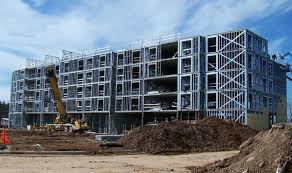
Type IIB Construction for Mid-Rise Residential: IBC Compliance and Cost Benefits
What Is Type IIB Construction Under the IBC
Type IIB construction is classified as "unprotected non-combustible" per IBC Chapter 6. Every structural element, including columns, beams, floors, and bearing walls, must be built from non-combustible materials such as cold-formed steel (CFS), concrete, or masonry. The "unprotected" designation means the structural frame carries a 0-hour fire-resistance rating per IBC Table 601, requiring no spray-on fireproofing, intumescent paint, or gypsum encasement on structural members.
For mid-rise residential developers, Type IIB delivers the durability and insurance advantages of non-combustible framing without the added expense of fire protection assemblies that Type IIA demands. The trade-off is compensated by automatic sprinkler systems per NFPA 13, which unlock significant height and area increases under IBC Section 504.2.
- Non-combustible: All structural materials must pass ASTM E136 non-combustibility testing
- Unprotected: Zero-hour fire-resistance rating for structural frame per IBC Table 601
- IBC reference: Classification defined in IBC Section 602.2
IBC Table 601 Fire-Resistance Requirements for Type IIB
Type IIB has zero-hour fire-resistance requirements across all structural elements per IBC Table 601. This is the key differentiator from Type IIA, which requires 1-hour ratings on structural frame, bearing walls, and floor construction. The 0-hour designation means non-combustible materials only, with no additional fire protection assemblies required on the structure itself.
Structural Frame and Bearing Wall Requirements
IBC Table 601 assigns 0-hour fire-resistance ratings to Type IIB's primary structural frame and interior bearing walls. In practice, this means cold-formed steel framing stays exposed without applied fireproofing. The non-combustible material itself, verified through ASTM E136 testing, provides the required fire performance without supplemental protection layers.
Floor Construction and Roof Construction Requirements
Floor and roof assemblies also carry 0-hour requirements under IBC Table 601, simplifying assembly design compared to Type IIA where 1-hour ratings drive more complex gypsum layering and resilient channel configurations. Important distinction: dwelling unit separations and corridor walls still require fire-rated assemblies per IBC occupancy separation requirements. Those fire-rating requirements are driven by occupancy classification, not construction type.
Exterior Wall Requirements per IBC Table 602
Exterior wall fire-resistance requirements depend on fire separation distance, the measurement from the building face to the property line or an imaginary centerline between buildings, per IBC Table 602:
| Fire Separation Distance | Required Rating |
|---|---|
| Less than 5 feet | 1 hour |
| 5 to 10 feet | 1 hour |
| 10 to 30 feet | 0 hour |
| Greater than 30 feet | 0 hour |
Site planning directly affects exterior wall requirements. A building positioned closer to property lines faces more stringent fire-resistance ratings regardless of construction type, making early site layout coordination essential for cost optimization.
Height and Area Allowances for Type IIB with R-2 Occupancy
Type IIB construction with R-2 occupancy (apartments, condominiums) and NFPA 13 sprinkler systems reaches 5 stories and 75 feet, the sweet spot for mid-rise residential development. This combination eliminates the concrete podium that taller wood-frame projects require while delivering favorable non-combustible insurance classification.
Base Allowances per IBC Table 504.3 and Table 504.4
For R-2 occupancy, Type IIB starts with base allowances of 4 stories and 55 feet in height per IBC Tables 504.3 and 504.4. Base area per floor is 11,000 square feet. These figures represent the conservative baseline before any code-permitted modifications.
Sprinkler Increases per IBC Section 504.2
Installing an NFPA 13 automatic sprinkler system unlocks one additional story and 20 feet of height per IBC Section 504.2, bringing Type IIB R-2 buildings to 5 stories and 75 feet. Area increases per IBC Section 506.3 can effectively triple the base allowable area when combined with frontage increases, enabling buildings well over 30,000 SF per floor on qualifying sites.
Frontage Increases per IBC Section 506.3
Buildings with open perimeter access, meaning fire department vehicles can approach multiple sides, qualify for frontage increases per IBC Section 506.3. The calculation considers the percentage of building perimeter with adequate access and open space. On urban infill sites with limited frontage, this increase may be minimal. Suburban sites with full perimeter access often capture the maximum benefit.
Type IIB vs. Type IIIA and Type VA for Mid-Rise Residential
Fire-Resistance Rating Differences
The fundamental distinction between these construction types lies in what the IBC requires for structural elements and which materials are permitted:
| Element | Type IIB | Type IIIA | Type VA |
|---|---|---|---|
| Structural Frame | 0 hr (non-combustible required) | 1 hr (combustible permitted) | 1 hr (combustible permitted) |
| Bearing Walls (Interior) | 0 hr (non-combustible required) | 1 hr (combustible permitted) | 1 hr (combustible permitted) |
| Floor Construction | 0 hr (non-combustible required) | 1 hr (combustible permitted) | 1 hr (combustible permitted) |
Type IIB's 0-hour ratings might appear less protective at first glance. However, the non-combustible material requirement per ASTM E136 provides inherent fire performance that combustible construction achieves only through applied protection layers, which can be compromised during a fire event.
Allowable Height and Area Differences
With NFPA 13 sprinklers, Type IIB and Type IIIA achieve similar building envelopes for R-2 occupancy: both reach 5 stories and 75 feet. The difference is not in what you can build but in how you build it and what happens over the building's lifecycle, including insurance classification, maintenance requirements, and catastrophic loss exposure.
Material Classification Differences per ASTM E136
Type IIB requires all structural materials to pass ASTM E136 non-combustibility testing. Cold-formed steel, concrete, and masonry qualify inherently without treatment. Types IIIA and VA permit combustible materials, including wood framing and fire-retardant-treated (FRT) lumber, for interior structural elements. This material distinction drives long-term performance differences in fire events, insurance classification, and maintenance requirements.
Cost Comparison by Building Height from 4 to 7 Stories
The economic case for Type IIB cold-formed steel construction strengthens with each additional story. At 5 stories, CFS reaches cost parity with wood. Above 5 stories, CFS delivers $13-21/SF savings through podium elimination, simplified fire assemblies, and faster erection schedules.
Four-Story Buildings: Wood Maintains First-Cost Advantage
At 4 stories, wood-frame Type VA construction typically costs less than CFS Type IIB. Per RSMeans 2024 data (Boston market), wood framing runs $14.50-16.50/SF versus CFS at $24.00-26.00/SF for structural framing scope. Labor familiarity and material availability favor wood at this height, though lifecycle costs including insurance and maintenance still favor CFS.
Five-Story Buildings: The Cost Parity Inflection Point
The economics shift decisively at 5 stories. FRT lumber requirements per IBC Table 504.3, enhanced fire-resistance assemblies, and increased structural demands bring wood-frame costs to $23.50-29.50/SF while CFS remains at $24.50-26.50/SF per SFIA market data. This is the inflection point where construction type selection becomes a genuine economic decision rather than a foregone conclusion.
Six and Seven-Story Buildings: CFS Delivers Measurable Savings
Above 5 stories, CFS Type IIB pulls ahead decisively. BuildSteel.org case studies document savings of $13.42/SF at 6 stories and $21.11/SF at 7 stories compared to wood-over-podium alternatives. Savings compound from four sources: podium elimination, simplified fire assemblies, faster erection schedules, and favorable non-combustible insurance classification.
Cost data reference: Figures reflect RSMeans 2024 and SFIA market reports. Material pricing volatility and regional labor rates affect project-specific economics. Obtain current quotes for accurate feasibility analysis.
Why Type IIB Cold-Formed Steel Becomes Cost-Effective Above Four Stories
Several mechanisms drive the cost crossover at taller building heights, making CFS the economically rational choice for 5+ story multifamily:
- FRT lumber escalation: Fire-retardant treatment adds 10-25% to lumber costs, reduces structural capacity requiring larger members, and demands stainless steel fasteners adding $0.25-0.40/SF
- Podium elimination: Concrete podium construction for taller wood buildings adds significant cost and 8-12 weeks of schedule
- Simplified assemblies: 0-hour structural ratings per IBC Table 601 reduce fire-protection assembly complexity and material layers
- Insurance classification: Non-combustible buildings receive favorable underwriting per SFIA lifecycle studies, compounding annually over the hold period
Eliminating Type IA Podium Construction with Full-Height Type IIB CFS
Podium Construction Cost and Schedule Impacts
Traditional mid-rise design often places wood framing atop a Type IA concrete podium. The concrete base provides the non-combustible platform required for taller wood structures per IBC height limitations. This approach adds substantial cost in concrete forming, reinforcement, and curing time, and extends schedules by 8-12 weeks per floor of podium construction.
Full-Height CFS Schedule Advantages
Full-height CFS framing eliminates the concrete podium entirely. Panelized components arrive prefabricated and sequenced for installation, enabling faster floor-to-floor cycle times with reduced weather sensitivity. Factory-controlled manufacturing using precision HOWICK roll-forming machinery with advanced CAD modeling means components fit to plus or minus 1/8" tolerances per AISI S240, reducing field adjustments and construction errors.
Insurance Premium Reduction from Non-Combustible Classification
Insurance underwriters classify non-combustible Type IIB buildings in more favorable risk categories than combustible Type IIIA/VA construction. Over a 30-year building lifecycle, this classification difference translates to 15-25% premium reductions per SFIA and BuildSteel.org studies. Specific premiums depend on carrier, location, and building-specific factors, but the non-combustible classification consistently delivers lower rates.
Non-Combustible Materials Qualifying for Type IIB per ASTM E136
Cold-Formed Steel Framing per AISI S240
Cold-formed steel (CFS) framing, steel sheet formed at room temperature into structural shapes, serves as the primary framing material for Type IIB mid-rise construction. AISI S240 governs CFS framing design, covering wall stud assemblies, floor joists, and roof framing. CFS is inherently non-combustible per ASTM E136, requiring no treatment or certification to meet Type IIB material requirements.
Steel Grades and Member Specifications per ASTM A1003
CFS framing uses ASTM A1003 structural steel, typically SS Grade 33 or SS Grade 50 depending on loading requirements. Member depths range from 3-5/8" to 12" with gauges from 33 mil (20 gauge) to 97 mil (12 gauge). AISI S100 provides structural design provisions, including the effective width method for calculating member capacities under various loading conditions.
Fire-Rated Assemblies and UL Design Numbers for Type IIB CFS Construction
While Type IIB structural elements carry 0-hour fire-resistance ratings, fire-rated assemblies remain necessary for dwelling unit separations, corridor walls, and floor-ceiling assemblies per IBC occupancy separation requirements. These assemblies use tested and listed UL designs to achieve required ratings.
Floor-Ceiling Assemblies: UL Design L500 Series
UL L-series designs (L500, L501, L541) provide tested floor-ceiling assemblies for CFS construction. Assemblies specify CFS joist sizes, gypsum board layers (typically 5/8" Type X), resilient channel spacing, and structural deck products. Following tested parameters exactly is essential; any substitutions void the fire rating and compromise code compliance.
Load-Bearing Wall Assemblies: UL Design U400 Series
UL U-series designs cover load-bearing CFS wall assemblies. UL U425, for example, specifies stud gauge, gypsum board layering, and screw spacing (typically #6 Type S screws at 12" o.c. field, 8" o.c. edges) to achieve rated performance. Strict adherence to tested configurations maintains the listing through the life of the building.
Massachusetts 780 CMR Amendments for Type IIB Mid-Rise Construction
Massachusetts adopts the IBC with amendments under 780 CMR. While base height and area provisions generally align with model code, local jurisdictions may impose additional requirements. Always verify the current 780 CMR edition and local amendments for project-specific compliance before finalizing construction type selection.
The Massachusetts stretch energy code affects CFS construction through thermal bridging considerations. Continuous insulation strategies and ASHRAE 90.1 Appendix A Modified Zone Method calculations address steel's thermal conductivity in energy compliance documentation. Early coordination with energy consultants ensures CFS wall assemblies meet both structural and thermal performance requirements.
Common Construction Type Selection Mistakes to Avoid
Misapplying IBC Sprinkler and Frontage Increases
Height and area increases do not stack without limits. IBC Section 506 provides specific calculation methodology. Verify that combined increases do not exceed code maximums and that your site actually qualifies for claimed frontage increases based on measured open perimeter access.
Overlooking Exterior Wall Fire Separation Requirements
Exterior wall fire-resistance ratings per IBC Table 602 apply regardless of construction type. A Type IIB building positioned 4 feet from the property line still requires 1-hour exterior walls. Site planning decisions made early in design directly affect exterior wall assembly complexity and cost.
Underestimating FRT Lumber Cost Escalation
Initial budgets using standard lumber pricing consistently underestimate actual costs for 5+ story wood construction. FRT lumber's 10-25% cost premium, structural capacity reductions requiring larger members, special stainless steel fastener requirements, and extended lead times create budget surprises that shift the economic comparison decisively toward CFS.
Next Steps for Type IIB Cold-Formed Steel Project Feasibility
Evaluating Type IIB CFS for a mid-rise residential project involves three critical workstreams:
- Construction type analysis: Verify IBC compliance for specific height, area, and R-2 occupancy parameters per Tables 504.3, 504.4, and 506.3
- Cost modeling: Compare Type IIB CFS against podium/wood alternatives using project-specific RSMeans data and current material pricing
- Design coordination: Engage a CFS fabricator early to define delegated design scope per AISI S240 and integrate with BIM workflow for clash detection
Frequently Asked Questions About Type IIB Mid-Rise Construction
Does Type IIB construction require fire-rated structural frame protection?
No. Type IIB is "unprotected non-combustible," meaning structural elements are non-combustible per ASTM E136 but carry 0-hour fire-resistance ratings per IBC Table 601. No applied fireproofing, intumescent paint, or gypsum encasement is required on the structural frame.
What is the maximum building height allowed for Type IIB construction with R-2 occupancy and automatic sprinklers?
Per IBC Tables 504.3 and 504.4 with NFPA 13 sprinkler modifications under IBC Section 504.2, Type IIB R-2 buildings can reach 5 stories and 75 feet. Verify the current code edition and local amendments, as Massachusetts 780 CMR may have specific provisions affecting these allowances.
Can cold-formed steel framing qualify as non-combustible material for Type IIB classification?
Yes. Cold-formed steel is inherently non-combustible per ASTM E136 testing, making CFS framing fully compliant with Type IIB material requirements under IBC Section 602.2 without additional treatment or certification.
How does non-combustible classification affect building insurance premiums?
Insurance underwriters classify non-combustible Type IIB buildings more favorably than combustible Type IIIA/VA construction. SFIA and BuildSteel.org studies document 15-25% premium reductions over building lifecycles, though specific savings depend on carrier, location, and building-specific characteristics. Over 30 years, cumulative savings can be substantial.
Evaluating Type IIB CFS for your next mid-rise project? AAC Steel Engineering provides construction type feasibility analysis, cost modeling, and early-stage design coordination for 4-7 story residential developments throughout Massachusetts and the Northeast. Contact AAC Steel Engineering to start your feasibility analysis.