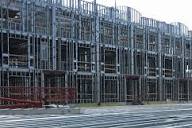
Fire-Rated CFS Wall Assemblies: UL Design Guide for Multifamily Mid-Rise
What Are Fire-Rated CFS Wall Assemblies
Fire-rated cold-formed steel (CFS) wall assemblies are tested systems that combine steel studs, multiple layers of 5/8" Type X gypsum board, and mineral wool insulation to achieve 1-hour or 2-hour fire resistance ratings per ASTM E119 testing. UL designs such as U425, U423, V438, and U466 document the exact construction specifications required to resist fire spread for a specified duration in multifamily mid-rise buildings.
A fire-rated assembly functions as a complete tested system, not a collection of individual materials. Every component—stud gauge, gypsum thickness, screw spacing, insulation type—works together as validated by ASTM E119 fire endurance testing. Changing any single element voids the fire rating.
Fire Resistance Rating vs. Fire Protection Rating
Two distinct rating types appear in fire-rated construction:
- Fire resistance rating: The duration a wall, floor, or structural element maintains structural stability and prevents fire passage when tested per ASTM E119
- Fire protection rating: The duration individual components like fire doors or dampers perform their specific function
A 1-hour fire-rated wall assembly carries a fire resistance rating. The fire door within that wall carries a fire protection rating—typically 45 minutes for a 1-hour wall per IBC Table 716.1.
ASTM E119 Fire Test Procedure for Wall Assemblies
ASTM E119 testing exposes one side of a wall assembly to a standardized time-temperature curve reaching approximately 1,000°F at 5 minutes and 1,700°F at 1 hour. Instruments on the unexposed side measure temperature rise throughout the test duration. After fire exposure, the assembly faces a hose stream test simulating firefighting conditions. To earn a 1-hour or 2-hour rating, the wall must not allow flame passage, must not exceed temperature limits on the cool side, and must not collapse under load.
Non-Combustible Classification per ASTM E136
ASTM E136 testing determines whether a material contributes fuel to a fire. Cold-formed steel passes this test and qualifies as non-combustible, directly affecting construction type options under IBC Table 601. CFS framing enables Type I and Type II non-combustible construction, while wood framing—even fire-retardant-treated (FRT) lumber—remains combustible and limits buildings to Type III, IV, or V classifications.
How UL Wall Assembly Ratings Work for CFS Construction
The UL Fire Resistance Directory contains hundreds of tested wall designs, each with an alphanumeric designation specifying exact construction requirements. Architects and specifiers use these UL design numbers to select compliant assemblies and maintain IBC code compliance for multifamily projects.
Understanding UL Fire Resistance Directory Design Numbers
UL organizes fire-rated assemblies by letter prefix: U-series for walls, L-series for floor-ceiling assemblies, and additional prefixes for roofs, columns, and beams. The complete UL Fire Resistance Directory is available through UL's Product iQ database with free registration. Each design number links to detailed specifications including stud sizes, gypsum types, fastener patterns, and required accessories such as resilient channels or specific insulation products.
Load-Bearing vs. Non-Load-Bearing Assembly Classifications
Load-bearing assemblies carry structural loads from floors or roofs above. During ASTM E119 fire testing, load-bearing assemblies must maintain structural integrity while supporting design loads. Non-load-bearing partitions only prevent fire passage and limit heat transfer. Different UL designs apply to each type—specifying a non-load-bearing assembly for a structural wall violates both the UL listing and IBC requirements.
Critical Parameters That Affect UL Rating Compliance
Every parameter in a UL design represents a tested condition. Deviations from any parameter can void the fire rating entirely:
- Stud depth and gauge: Specific member sizes such as 3-5/8" x 25 gauge per AISI S100 design provisions
- Gypsum board type and thickness: Type X designation with 5/8" minimum per ASTM C1396
- Fastener specifications: Screw type, size, and spacing (typically #6 Type S at 12" o.c. field, 8" o.c. edges)
- Cavity insulation: Type and density when the specific UL design requires it
1-Hour Fire-Rated CFS Wall Assemblies and UL Designs
One-hour rated CFS wall assemblies typically use single-layer 5/8" Type X gypsum on each side of cold-formed steel studs, achieving the minimum fire resistance required for most corridor walls and dwelling unit separations in multifamily mid-rise buildings per IBC Section 420.2.
UL Design U425: Load-Bearing Steel Stud Assembly
UL Design U425 provides a 1-hour fire resistance rating for load-bearing CFS walls using 3-5/8" steel studs at 24" o.c. with one layer of 5/8" Type X gypsum each side. This design commonly appears in corridor walls and dwelling unit separations where structural loads transfer through the wall assembly.
UL Design U465: Non-Load-Bearing Steel Stud Assembly
UL Design U465 covers non-load-bearing partitions with single-layer Type X gypsum each side. This assembly serves interior partitions that do not carry floor or roof loads but require fire separation per IBC occupancy separation requirements.
Gypsum Board Layers and Screw Spacing Requirements
| Assembly Type | Layers per Side | Screw Spacing (Field) | Screw Spacing (Edges) |
|---|---|---|---|
| 1-Hour Load-Bearing (U425) | 1 layer 5/8" Type X | 12" o.c. | 8" o.c. |
| 1-Hour Non-Load-Bearing (U465) | 1 layer 5/8" Type X | 12" o.c. | 8" o.c. |
2-Hour Fire-Rated Wall Assembly Construction with CFS
Two-hour rated CFS wall assemblies require double-layer gypsum on each side, or single layers with resilient channels and specific stud configurations. These assemblies meet IBC requirements for exit stair enclosures, fire barriers, and occupancy separations in multifamily mid-rise construction.
UL Design U423: Two-Hour Load-Bearing Assembly
UL Design U423 achieves a 2-hour fire resistance rating using two layers of 5/8" Type X gypsum on each side of CFS studs per ASTM E119 testing. This assembly is specified for exit stair enclosures, fire barriers, and occupancy separations where IBC Table 601 requires 2-hour fire resistance.
UL Design U466: Two-Hour Non-Load-Bearing Assembly
UL Design U466 provides 2-hour fire protection for non-structural applications with double-layer construction. Layer sequence is critical: base layers attach directly to studs, while face layers attach through the base layer with longer screws to maintain tested performance.
Resilient Channel and Structural Deck Specifications
Some 2-hour UL designs incorporate 25-gauge resilient channels at 24" o.c. to improve both fire and acoustic performance. When specified, channels attach horizontally to studs with gypsum fastened only to channels—never directly to studs through the channel. This detail is frequently inspected and commonly cited for non-compliance.
IBC Fire Resistance Requirements for Multifamily Mid-Rise Buildings
The International Building Code establishes minimum fire resistance ratings based on construction type, occupancy classification, and building height. Understanding these requirements determines which UL-listed CFS assemblies apply to each location within the building.
IBC Table 601: Fire Ratings by Construction Type
| Construction Type | Primary Structural Frame | Bearing Walls (Exterior) | Bearing Walls (Interior) |
|---|---|---|---|
| Type IIA | 1 hour | 1 hour | 1 hour |
| Type IIB | 0 hours | 0 hours | 0 hours |
| Type IIIA | 1 hour | 2 hours | 1 hour |
IBC Table 602: Exterior Wall Requirements
Fire separation distance—measured from the building face to the property line or centerline of a public way—determines exterior wall fire ratings per IBC Table 602. Walls within 5 feet of the property line typically require 1-hour fire resistance with 0% openings for R-2 multifamily occupancy.
Height and Area Allowances per IBC Tables 504.3 and 504.4
Type IIA construction allows R-2 multifamily buildings up to 65 feet and 5 stories without sprinkler increases. With NFPA 13 sprinklers, allowable height increases to 85 feet and 6 stories per IBC Section 504.2—enabling mid-rise construction without concrete podiums. CFS framing qualifies for Type IIA non-combustible construction, potentially eliminating the Type IIIA podium that wood-framed buildings require above 4 stories.
Fire-Rated Assembly Requirements for Multifamily Occupancy Separations
R-2 multifamily occupancy triggers specific fire separation requirements between dwelling units and along corridors, all achievable with UL-listed CFS wall assemblies.
Dwelling Unit Separation per IBC Section 420
IBC Section 420.2 requires fire-rated separations between dwelling units, with ratings determined by construction type per IBC Table 601. Fire-rated assemblies must extend from the floor to the underside of the floor or roof deck above—not just to the ceiling line. This full-height requirement is a common inspection checkpoint.
Corridor Fire Ratings for R-2 Occupancy
Corridor walls in R-2 occupancy require 1-hour fire resistance when buildings lack NFPA 13 sprinkler systems per IBC Table 1020.1. With sprinklers, corridor ratings reduce to 0.5 hours in many configurations, though Massachusetts 780 CMR amendments and local jurisdictions may maintain higher requirements.
Penetration Firestop Requirements per ASTM E814
Every penetration through a fire-rated assembly requires a tested firestop system maintaining the assembly's rating. UL 1479 (ASTM E814) testing establishes F-ratings for flame passage and T-ratings for temperature rise. Firestop systems must match the specific wall assembly type—CFS assemblies require firestop configurations tested with steel framing, not wood.
CFS vs. Wood Fire-Rated Wall Performance
Material selection affects both fire performance and construction type classification under IBC, with direct consequences for building height allowances and total project cost at five stories and above.
Non-Combustible Steel vs. Combustible Wood Framing
Cold-formed steel qualifies as non-combustible per ASTM E136, enabling Type I and Type II construction classifications under IBC Table 601. Wood framing—even fire-retardant-treated (FRT) lumber—remains combustible and limits buildings to Type III, IV, or V construction, triggering podium requirements at mid-rise heights.
FRT Lumber Capacity Reductions and Fastener Requirements
When wood framing appears in Type III construction, FRT treatment reduces structural capacity by 10-25% per NDS adjustment factors and requires stainless steel or hot-dip galvanized fasteners to prevent corrosion. Both requirements add material cost and design complexity compared to CFS alternatives designed per AISI S100.
Long-Term Insurance Premium Differentials
Non-combustible CFS construction typically qualifies for lower insurance premiums over the building lifecycle per ISO construction classification differences. SFIA data indicates potential savings of up to 38.2% over 30 years compared to combustible construction types. The classification directly influences underwriting decisions throughout the building's operational life.
Cost Analysis for Fire-Rated CFS Wall Assemblies per RSMeans Data
Cost comparisons between CFS and wood fire-rated assemblies shift significantly at mid-rise building heights, where podium elimination and reduced gypsum layers create measurable savings.
CFS Assembly Costs at 5-7 Story Building Heights
Per RSMeans 2024 data (Boston market), CFS framing costs approximately $24-26/SF at 5-7 stories. Wood framing with FRT lumber and podium construction reaches $29-35/SF at similar heights. The cost crossover typically occurs around 5 stories, where CFS fire-rated assemblies achieve equivalent or superior ratings with fewer gypsum layers than wood alternatives.
Material pricing volatility and regional variations affect these figures. Verify current costs for project-specific estimates.
Podium Elimination Savings per Square Foot
Full CFS construction eliminates concrete podium requirements per IBC Type IIB classification, saving approximately $12-15/SF in construction costs plus 8-12 weeks of schedule per BuildSteel.org case studies. These savings compound with reduced fire protection material requirements inherent in non-combustible CFS assemblies.
Installation Requirements for Maintaining Fire-Rated Assembly Compliance
Proper installation per UL design parameters is essential to maintaining the tested fire rating. Deviations from specified configurations can void compliance entirely and create code violations during inspection per IBC Section 1705.11.
1. Pre-Installation UL Design Parameter Verification
Before installation begins, verify all materials match the specified UL design exactly: stud gauge and depth, gypsum board manufacturer and Type X designation per ASTM C1396, screw specifications, and any required accessories such as resilient channels or mineral wool insulation.
2. Gypsum Board Fastener Patterns and Sequences
Install perimeter screws first, then field screws, maintaining specified spacing throughout. Typical patterns require 8" o.c. at edges and 12" o.c. in the field—tighter spacing than non-rated assemblies. For 2-hour assemblies, base layer and face layer screw patterns differ and must follow the specific UL design.
3. Firestop Installation and Inspection per IBC Section 1705.11
IBC Section 1705.11 requires special inspection for fire-resistant construction, including verification that firestop systems match tested configurations per UL 1479 (ASTM E814). Document all penetrations and firestop installations for inspection records and future renovation reference.
4. Documentation and As-Built Requirements
Maintain UL design certificates, special inspection reports, and as-built drawings showing fire-rated assembly locations, types, and penetration firestop details. This documentation supports code compliance verification, certificate of occupancy, and future renovation planning.
Specifying Fire-Rated CFS Wall Assemblies for Multifamily Projects
Reference specific UL design numbers in project specifications rather than generic performance requirements—this approach ensures constructability, code compliance, and clear inspection criteria. Specifying by UL design number eliminates ambiguity for contractors and inspectors alike.
Frequently Asked Questions About Fire-Rated CFS Wall Assemblies
What is the NFPA code for fire-rated walls?
NFPA 101 Life Safety Code and NFPA 5000 Building Construction and Safety Code address fire-rated wall requirements, while IBC Tables 601 and 602 specify fire resistance ratings for specific construction types and fire separation distances. Most jurisdictions adopt IBC as the primary building code with NFPA standards referenced for specific fire protection systems.
What is a 60-60-60 fire-rated wall construction?
The 60-60-60 rating indicates 60 minutes of stability, 60 minutes of integrity (preventing flame passage), and 60 minutes of insulation (limiting heat transfer on the unexposed side). This terminology appears in international standards; U.S. practice typically uses single hourly ratings per ASTM E119 testing.
Can CFS wall assemblies achieve 3-hour fire ratings?
Yes. UL-listed CFS wall assemblies can achieve 3-hour and 4-hour fire resistance ratings using multiple layers of Type X gypsum and specific stud configurations. Higher-rated assemblies typically appear in occupancy separations and fire walls per IBC Section 706.
How do fire-rated CFS assemblies meet Massachusetts 780 CMR requirements?
Massachusetts 780 CMR adopts the IBC with state-specific amendments. UL-listed fire-rated CFS assemblies complying with IBC fire resistance requirements are acceptable under Massachusetts code when installed per tested UL design parameters and inspected per IBC Section 1705.11.
What STC ratings do fire-rated CFS wall assemblies achieve for multifamily dwelling unit separations?
Many fire-rated CFS wall assemblies achieve STC ratings of 50-60 or higher when designed with resilient channels and appropriate insulation, meeting or exceeding IBC Section 1207 requirements for STC 50 minimum between dwelling units.
Need project-specific UL assembly recommendations for your multifamily mid-rise? AAC Steel's engineering team provides fire-rated assembly analysis using advanced CAD modeling and AISI S100-verified load-bearing calculations, tailored to your building's IBC construction type and occupancy requirements. Contact AAC Steel for fire-rated assembly consultation.